Sunday, February 21, 2010

Not the next book in the series


This is when we start skipping around in the Trixie Belden timeline. You may have noticed that the last book was #8, and now we're on Book 10. There's a very simple reason for it: I'm lazy. I've never acquired a copy of Trixie Belden and the Happy Valley Mystery (though I have read it, and can tell you that it involves Iowa, agriculture, basketball, and a boat ride) and don't expect to pick up a copy any time soon.

(Defensive? Moi? Hardly. Just disorganized.)

Anyway... instead we'll move on, to a world of child prodigies, herbal remedies, pirate legends, and unique names.

I'm serious about that last one. Ezarach Martin is a character in The Marshland Mystery (1962), part of said pirate legends. And according to Google, that's the only place that name turns up. The search yields matches from Trixie references, the e-mail addresses of several people with the last name Zarach, and pages in a language I don't read. It would seem that whoever wore the Kathryn Kenny hat this time around made it up.

The child prodigy is a diminutive violinist named Gaye Hunya, of some never-defined European background. (Also unanswered: If her guardian, Miss Crandall, is her father's sister, then where does Gaye's last name come from?)

Gaye's in town to perform as guest soloist with the local symphony, and she and Miss Crandall spend a few days at Manor House. From her first appearance, she's well on her way to diva status, as Brian explains:
"Our temperamental little friend is to appear as guest soloist with the symphony. And she gave a recital at Carnegie Hall when she was only five years old. Her father was a famous European violinist."
Naturally, she makes a complete nuisance of herself, just when Trixie has decided to go into plant collecting on behalf of her science teacher. Mart doesn't make it easy for her to figure out where to find specimens:
"There is one, but you probably didn't think of it as a swamp. It's called Martin's Marsh, but that would convey nothing to you, dear sister, because you, with your complete lack of familiarity with you native tongue, could hardly be expected to realize that marsh is simply a synonym for swamp."
Ah, Mart. Not so high-and-mighty after you dump blueberry pie all over your shirt, are you?

Thanks to Mart's clumsiness, I now know (at least in theory) how to get blueberry juice out of clothing. I also know that tansy is thought to be a freckle remover - oh, and white settlers pretty much figured out how to use native plants all by themselves. Seriously, I couldn't read this exchange without imagining Debbie Reese's reaction:
"Oh, yes. Miss Bennett says that when the pioneers were living in deep forests miles and miles from any doctors, they had to make up remedies for practically everything. I suppose they had to experiment a lot before they found the right ones. Of course, they learned a lot from the Indians."

Honey looked impressed. "I never thought of the Indians as people who needed medicine. The pictures always show them marvelously healthy, even if they must have nearly frozen lots of times, not wearing much clothing!"
Moving on, because I just don't know what I can say about that...

A couple other tidbits from the text:
  • The Wheeler household has expanded to include a butler and some assistant grooms. It's hard to picture Regan allowing anyone else in his stables, but whatever.
  • Sergeant Rooney represents Sleepyside's finest this time, instead of Sergeant Molinson. Feel free to correct me, but I don't believe Rooney gets any more appearances.
  • I can't take credit for this one, but - Di and Honey tease Trixie about the bracelet Jim gave her in Book 9, even though they "knew it wasn't really a sentimental gift, but they liked to make Trixie blush." Since when does "you're my special girl, Trixie" count as not sentimental?
  • Who says TV isn't educational?
    Trixie's blue eyes sparkled suddenly, and she reached over and pulled a bobby pin from one of Honey's long golden-brown tresses. "Let's turn burglar! I saw a girl in a TV show use one of these to open a door."
  • As always, Diana gets the opportunity to show that she's not the smartest Bob-White in the Glen:
    "Probably a bottle of myrrh, whatever that is," Di said dreamily. "Why don't people write romantic things like that nowadays?"
    Okay, so it was used in perfume. Still, "romantic" isn't the first thing I'd associate with myrrh.
Oh, and about that pirate thing:
"The legend is that Captain Kidd, the notorious pirate, was a friend and business partner of old Ezarach Martin, who owned all the land for miles around the swamp. So it was natural to suspect that Kidd buried a lot of his treasure in the swamp."
Ezarach (and his name) may have been made up by the Kathryn-Kenny-of-the-moment, but the Captain-Kidd-on-the-Hudson story wasn't. Although we tend to equate the golden age of piracy with the Caribbean (even before Johnny Depp rocked the kohl), Kidd reportedly spent a fair bit of time up this way, and as a result there are, in fact, rumors of his treasure being buried somewhere along the Hudson.

I'm not much for digging up swamps, but if you ever come across a pile of doubloons in Westchester, let me know.

A mitzvah?


Diversity - or more properly, the lack thereof - in kidlit has been a hot topic in our corner of the blog world lately. Some of the discussion has focused on historical fiction and its insistence on focusing on particular periods, especially slavery and the Holocaust.

Which is why this paragraph from recent non-kidlit reading caught my eye:
"To the 613 mitzvot counted by the rabbis, [Emil] Fackenheim added one: Thou shalt not grant Hitler a posthumous victory... Part of the obligation of this commandment rests with Holocaust remembrance, but it can go too far. We can read only so many books... Of those that have Jewish content, what percentage should be about the Shoah? Ten? Fifty? At what age should children be taught about these horrific events?... If the child cannot respond and later feels that she already knows all about it, the impact of remembrance is lost."
It's from Unsettled: An Anthropology of the Jews, by Melvin Konner.

Sunday, January 24, 2010

Unsung YA

Taking a page from YAnnabe and others, some favorite overlooked YA. Follow the link to see other bloggers' far more detailed lists.

Diary of a Chav, Grace Dent
Climbing the Stairs, Padma Venkatraman
Gamma Glamma, Kim Flores
Fact of Life #31, Denise Vega
The Kayla Chronicles, Sherri Winston
The Primrose Way, Jackie French Koller
Not a Swan, Michelle Magorian
Trouble, Gary Schmidt
The Seventh Raven, Peter Dickinson
The Pistachio Prescription, Paula Danziger
The Brightest Light, Colleen O'Shaughnessy McKenna
The Dancing Meteorite, Anne Mason
Sister to the Wolf, Maxine Trottier
In Lane Three, Alex Archer, Tessa Duder
Children of the River, Linda Crew
The Amethyst Road, Louise Spiegler
Just Jane, William Lavender
Tomorrow, the River, Dianne Gray
Jim Thorpe, Original All-American, Joseph Bruchac
Who's Your Daddy?, Lynda Sandoval
Honey Blonde Chica, Michele Serros
Looking for Alibrandi, Melina Marchetta
Carpe Diem, Autumn Cornwell

Saturday, January 23, 2010

Going to be pondering this one for a while


Like most independent booksellers, I've got my complaints about Amazon.com. But their Amazon Encores program is doing at least one thing right - bringing new attention to Zetta Elliott's A Wish After Midnight.

I know I'm late to the party on this one, but wow.

Short version: You'd think Gemma had enough to deal with in contemporary Brooklyn, but no, she timeslips back to 1863, when Brooklyn was its own city and the Civil War was well underway. And then she's stuck for a while. See all the other reviews I linked to for a more comprehensive plot summary; I'm more in the mood to talk about specifics.

  • There's an obvious Kindred parallel here - modern black female ends up back in pre-Emancipation America and all that entails, Gemma manages to bring her boyfriend back and that throws all sorts of snags into their relationship - but AWAM stands alone. Not the same story, not the same conclusions, and absolutely nothing wrong with taking inspiration from Octavia E. Butler.
  • The Latin Americanist in me is intrigued by the choice to make Gemma half-Panamanian. It's not one of the countries I'm best informed on, but I do know it has a considerable Afro-Latino population. (And that part of me also cringed when Gemma's mother said her daughter was black, not Latina. Would love to know if that side of Gemma's ancestry is going to figure in the sequel.)
  • You want to read a book with a sense of place? AWAM's got it. This isn't overdone hipster Brooklyn; it's a vividly drawn world that we tend to ignore when we think about that borough.
  • So much about women's roles here, both in the contemporary and historical sections. Still trying to organize my thoughts about the space between conforming for survival and selling out, Gemma and Judah's relationship, and women who are left alone.
  • Love, love all the allusions and name-dropping. Five Points, Henry Ward Beecher's "mock auctions" - and if you're at all familiar with Glory, you can't help but cringe when Paul decides to join up with a Massachusetts regiment. *That* I want to see more of in the sequel, but only if he doesn't end up on that beach in South Carolina.
Source: ARC shared by Doret, who probably got it from Amazon somewhere along the line. Review copy, in other words. And I'm happy to share it with someone else. Leave a comment if you want to be next!

Sunday, January 17, 2010

West(chester) Side Story


There are no choreographed fights in the eighth Trixie Belden book, The Black Jacket Mystery (1961), but the threat of gangs in this book does have a rather stage-drama feel to it.

First, an aside: This may be in the front matter of the other Trixie reissues, but this is the first time I've noticed it.
This is a reissue edition of a book that was originally published in 1961. While some of the words have been changed to regularize spelling within the book and between books in the series, the text has not been updated to reflect current attitudes and beliefs.
True that. It's part of their charm, but shouldn't go unnoticed.

The meat of this story is Regan's nephew Dan Mangan, brought up from New York thanks to a judge whose first instinct is not to lock up juvenile offenders (maybe the current overseers of New York's system should be reading this, after all), but let's take a detour first, to some of the fun bits.

Have I mentioned that Mart is adorable? Have I not convinced you yet? Read on:
Lately he had grown a couple of inches taller than Trixie and was extremely proud of it, except that he was growing out of his clothing.
No one said growing up was easy, Mart. But those extra couple inches make the whole almost-twin thing easier to deal with, I'm sure. But not when Trixie's finally got a comeback for you:
But this time, Trixie didn't merely sniff at her teasing brother as usual. Instead, the glare faded into a cool stare as she said very deliberately, "The use of too many polysyllabic words is definitely a symptom of immaturity." Brian had spent half an hour at lunchtime drilling her in that answer in preparation for just such a moment. She wasn't entirely sure what all the words meant, but Brian had assured her it would stop Mart in his tracks if she didn't bungle it.
I love the idea of Trixie practicing this line over and over.

And then there are the bits that remind us how far we've come - or perhaps not. How many executive wives have to deal with this today? Her father's business connections made it necessary for her mother to be very social. And lots of times they had to rush off to Washington or some other place at a moment's notice.

Okay, on to Dan. The surburbanites are suspicious of him from the start.
A moment later, a boy who looked about Mart's age came up the step. He had a thin, dark face, and was wearing a peaked black cap with a patent-leather band, and a broad-shouldered black leather jacket with the collar turned up. His black eyes peered out from under the shiny visor of the cap and swept the length of the bus, almost as if he expected to see some danger there.
Trixie - who, may I point out, wears a jacket with her own club's name on the back - dislikes him straight off.
"That black leather jacket! Ugh! I expected to see some crazy club name on the back of it when he sat down!"

"That's strange." Honey looked started. "I did, too!" Then she giggled. "I guess we've seen too many movies."
Just in case that doesn't turn your thoughts to Blackboard Jungle, Diana Lynch draws from her vast experience to analyze the newcomer.
Di's eyes were wide. "I saw a movie about a street gang that wore black leather jackets. They were awful. Always fighting. Do you think he's like that?"
The Bob-Whites have had little interaction with Dan as they leap to conclusions, but he's not doing much to forward his own cause.
"Nobody tells us what to do around our neighborhood. We take care of that!... Switch blades? Not us! The cops get tough when they find 'em on you. We don't need stuff like that."
But, as it turns out, Dan - who was indeed a gang member, so I suppose I can't mock Trixie's assumptions too much - is finally ready to reform. But that doesn't mean the apparel-based prejudices are gone.
"We can't have him seen around in that black leather jacket, once he joins the B.W.G.'s," he said soberly.

"Yes!" Trixie nodded. "It was the black leather jacket that set me against him from the first, and lots of other people may feel the same way, because so many tough characters wear them."
Welcome to the club, Dan.

(Post pics are from my brother's high school production of West Side Story. In this case, the suburban kids were playing the gangsters.)

Wednesday, January 13, 2010

First 10-10-10 update

Since Melissa (and let me tell you, it's very odd to refer to her as anything other than @PermanentPaper) points out that a book can count in multiple categories, I get to make this list look more impressive than it actually is:

1. Shakespeare-related
Shakespeare: The World As a Stage, Bill Bryson
2. Poetry
3. Biography
Shakespeare: The World As a Stage, Bill Bryson
4. Contemporary young adult
Sweet, Hereafter, Angela Johnson
5. Children's non-fiction
Honeybees: Letters From the Hive, Stephen Buchmann
6. Science fiction
7. History
8. Mystery
Poirot Investigates, Agatha Christie
The Seven Dials Mystery, Agatha Christie
9. Written before 1900
Robinson Crusoe, Daniel Defoe
10. Pulitzer winners

Saturday, January 9, 2010

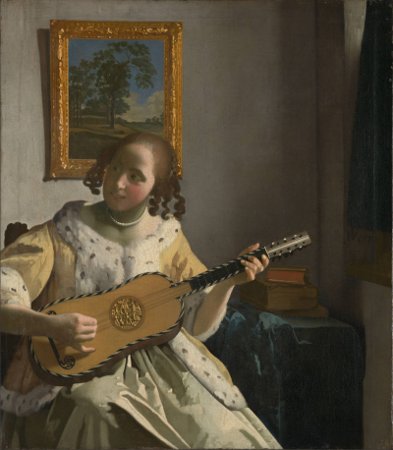
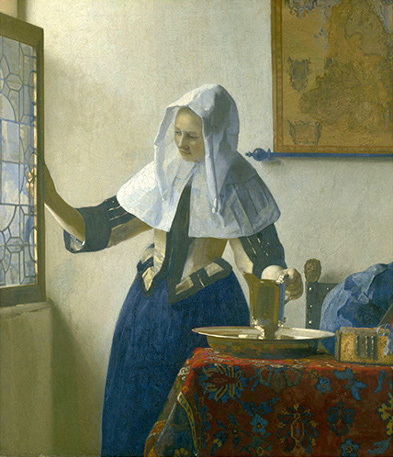
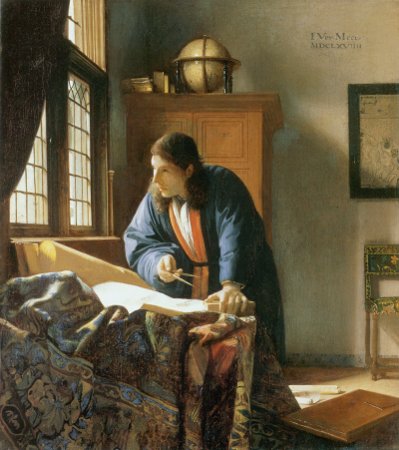
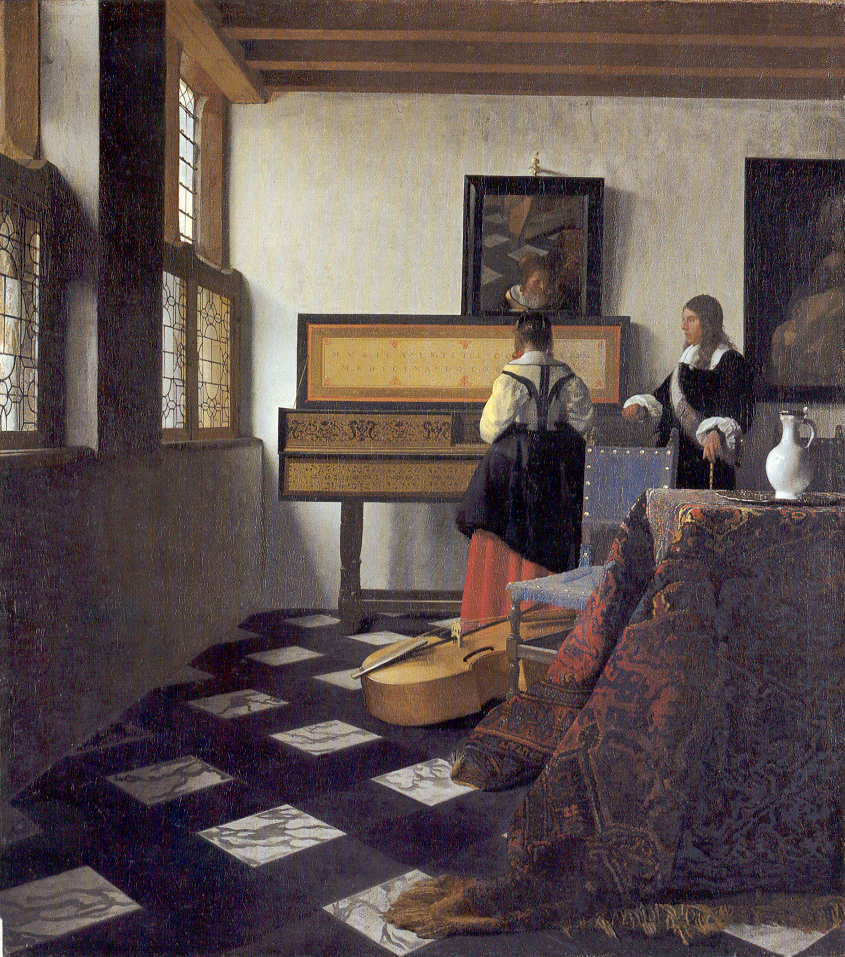
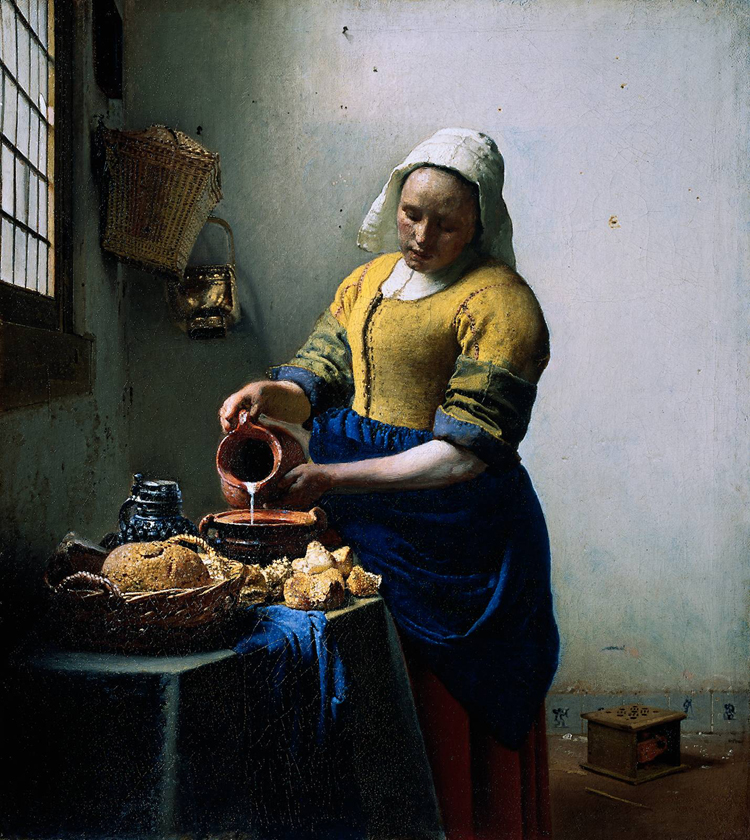
The Vermeer you (probably) don't know


The entire known work of Johannes Vermeer fits on one not-too-long screen on the front page of the website that catalogs his work. Experts generally agree that 34 paintings are his, and there are a couple more possibilities.

Which makes Bob Raczka's in-depth look at seven of them in The Vermeer Interviews a pretty thorough introduction. If you're not familiar with anything beyond the uber-famous Girl With a Pearl Earring, add this book to your list.

Raczka doesn't talk about the paintings as much as he talks to them, and to their subjects. The book is organized as a series of interviews with the milkmaid, the music student, the geographer, and their compatriots.

The interviews bring out technical details about the paintings - the use of light and dark, the possibility that Vermeer used a camera obscura, the fact that scholars have identified the map and globe featured in The Geographer - and speculate on what, precisely, is depicted. (Is Anton van Leewenhoek the model for some of the paintings? Does finding that possibility intriguing mark me as a nerd once again?)

(YA tie-in: The Concert, a Vermeer painting not included in the book, was one of the works taken in the 1990 Gardner heist. So if you're looking for a non-fiction book to pick up after Heist Society has stoked your interest in the history of art theft, try this one.)

The Vermeer Interviews was a Cybils MG/YA non-fiction nominee. The review copy was provided by the publisher.