Showing posts with label reviews. Show all posts

Friday, September 16, 2011

New feature: tidbits

After months of telling people that I don't review new releases here, I'm suddenly a bookseller again. Which means I need to read a lot of new releases, and have something intelligent to say about them.

And it's way easier to do that here at Archimedes Forgets than keeping track of everything myself.

But the thing is, I don't review because I'm bad at it. I can do a passable job of telling you why to read something I like, but I'm just no good at analyzing why it works, or anything like that. And I can assure you that phrases like "luminous prose" are not going to start popping up here.

So I think it's time for a new feature here: tidbits. Consider them virtual shelftalkers, if you like; you might see some of them appearing on paper at the bookstore.

Tuesday, March 15, 2011

From the Better-Late Files: An Old-Fashioned Girl


Finally got around to An Old-Fashioned Girl, rather a bit later for Mitali's cuci mata reading.

Not much to add to the questions and critiques Gail Gauthier raised back in December, except to say this:

Despite all the heavy-handed Important Life Lessons in the book (and Polly's pronounced Pollyanna tendencies), I was totally hooked on the relationships between the characters. I had to find out if Polly and Tom were going to end up together, and if Fanny was ever going to get over herself.

And on a related note, I much preferred the second half of the story to the first.

Tuesday, September 21, 2010

Read These Books

A couple weeks ago my little sister Dom* asked for book suggestions. I used moving as an excuse to procrastinate for a while, but finally got around to pulling together a list of some of my favorite books from this year.

(Okay, the capsule reviews are kind of cheating, since I totally intended to write more about these books. But it's better than just intending and forgetting, right?)

Poison Penmanship, Jessica Mitford. I had a copy of this book back in high school, but after it sat untouched on my bookshelves for years, I ended up getting rid of it unread. What was I thinking? This would have been the perfect thing to read every time I hit an aspiring-journalist phase. Mitford starts out with a quick version of what she teaches to j-school students, then comments on each piece - what the editor changed, what she thinks of it years later, how she got the key interviews. Very glad NYRB Classics brought this one back into print. (Source: review copy courtesy of the lovely @NYRBClassics, who's been putting up with my gushing on Twitter)

Diamond Ruby, Joseph Wallace. I probably would have picked this book up even if I hadn't first met the author through Twitter, as I spent a couple years in middle school trying to be Geena Davis in A League of Their Own. Jazz Age Brooklyn, baseball, rum runners, and plenty of real-people cameos come together beautifully, and - I'll try to say this in as un-spoilerish a way as possible - when I thought the author was about to do something terrible to one of his characters, he didn't, which just made me love him that much more. (Source: ARC)

Forge, Laurie Halse Anderson. It's a sequel, but I think it's a good starting point even if you haven't read Chains. The title refers to Valley Forge, where former slaves Curzon and Isabel are encamped with the Continental army, but also to - well, you'll find out about halfway through. And after just saying that I adore Joe Wallace for not doing awful things to his characters, one of the awesome things about Forge is LHA's willingness to put her characters in a bad situation and then make it worse, but not scare me off. And the cover is gorgeously Kara Walker-ish, no? (Source, ARC)

Hellhound on His Trail, Hampton Sides. Even though anyone who reads this probably already knows how it's going to end - the name James Earl Ray does mean something to you, doesn't it? - this book still reads like a thriller. Sides did a great job recreating the sequence of events surrounding Martin Luther King, Jr.'s assasination. (Source: ARC)

The Madame Curie Complex, Julie Des Jardins. Thanks to Colleen for putting me onto this one. For the record, I studied astronomy at a women's college, in an observatory named after a woman, using computers named after female astronomers (so much more interesting than naming them OBS001 or something like that) - so this is a topic of interest to me. Which meant I was willing to slog through some unfortunate formatting that made the book appear way more dry and academic than it actually is. Look past the footnotes at the end of each chapter (endnotes, people, please - we all know how to flip pages) and give it a try. (Source: library)

My Most Excellent Year, Steve Kluger. As Stephen** points out in his Guys Lit Wire review, this book requires some degree of suspension of disbelief, but it's so worth it. The book is funny, the story moves along, and - well, just trust me on this one. (Source: acquired in the ABA lounge at BEA 2008, and yes, it took me this long to get around to it. Should have read it sooner.)

Major Pettigrew's Last Stand, Helen Simonson. I finally got around to reading this one after Ron Charles' rave in the Washington Post, so I have to admit I'm pretty much cribbing from him when I say that this book works because it's a wide-eyed story of a second chance at love. And the intercultural angle (he's English; she's Pakistani) comes off well, without being either forced or condescending. (Source: ARC)

Android Karenina, Quirk Books. Sorry, but I can't bring myself to list the authors here as "Leo Tolstoy and Ben H. Winters." I'm so not a fan of the "remake classics with paranormal elements" thing from the past year or so. I want nothing to do with Pride & Prejudice & Zombies. And yet... my boss handed me this one, and I decided to take a look - and liked it. It's sort of Imperial Russia steampunk loosely based on Anna Karenina, and the aliens/robots/cyborgs storyline actually works. You probably have to have read the original to appreciate it, though. (And no, it did not change my feelings about P&P&Z and its cousins one bit.) (Source: ARC)


*My Wellesley little sister, not an actual sister. I don't have any of those.
** My actual little brother.

Saturday, May 29, 2010

Sacred Mountain Everest

Sacred Mountain Everest, by Christine Taylor-Butler (Lee & Low)

This is a long-overdue Cybils review, but let's start with the important question: how did I not know that Edmund Hillary was a beekeeper until I read this book?

Sacred Mountain Everest is a very cool book, covering some of the familiar history while giving full credit to the Sherpas who made the climbs alongside the famous names.

Seeing the author tweet this, six months after I read the book? Also very cool:

Saturday, January 23, 2010

Going to be pondering this one for a while


Like most independent booksellers, I've got my complaints about Amazon.com. But their Amazon Encores program is doing at least one thing right - bringing new attention to Zetta Elliott's A Wish After Midnight.

I know I'm late to the party on this one, but wow.

Short version: You'd think Gemma had enough to deal with in contemporary Brooklyn, but no, she timeslips back to 1863, when Brooklyn was its own city and the Civil War was well underway. And then she's stuck for a while. See all the other reviews I linked to for a more comprehensive plot summary; I'm more in the mood to talk about specifics.

  • There's an obvious Kindred parallel here - modern black female ends up back in pre-Emancipation America and all that entails, Gemma manages to bring her boyfriend back and that throws all sorts of snags into their relationship - but AWAM stands alone. Not the same story, not the same conclusions, and absolutely nothing wrong with taking inspiration from Octavia E. Butler.
  • The Latin Americanist in me is intrigued by the choice to make Gemma half-Panamanian. It's not one of the countries I'm best informed on, but I do know it has a considerable Afro-Latino population. (And that part of me also cringed when Gemma's mother said her daughter was black, not Latina. Would love to know if that side of Gemma's ancestry is going to figure in the sequel.)
  • You want to read a book with a sense of place? AWAM's got it. This isn't overdone hipster Brooklyn; it's a vividly drawn world that we tend to ignore when we think about that borough.
  • So much about women's roles here, both in the contemporary and historical sections. Still trying to organize my thoughts about the space between conforming for survival and selling out, Gemma and Judah's relationship, and women who are left alone.
  • Love, love all the allusions and name-dropping. Five Points, Henry Ward Beecher's "mock auctions" - and if you're at all familiar with Glory, you can't help but cringe when Paul decides to join up with a Massachusetts regiment. *That* I want to see more of in the sequel, but only if he doesn't end up on that beach in South Carolina.
Source: ARC shared by Doret, who probably got it from Amazon somewhere along the line. Review copy, in other words. And I'm happy to share it with someone else. Leave a comment if you want to be next!

Sunday, January 17, 2010

West(chester) Side Story


There are no choreographed fights in the eighth Trixie Belden book, The Black Jacket Mystery (1961), but the threat of gangs in this book does have a rather stage-drama feel to it.

First, an aside: This may be in the front matter of the other Trixie reissues, but this is the first time I've noticed it.
This is a reissue edition of a book that was originally published in 1961. While some of the words have been changed to regularize spelling within the book and between books in the series, the text has not been updated to reflect current attitudes and beliefs.
True that. It's part of their charm, but shouldn't go unnoticed.

The meat of this story is Regan's nephew Dan Mangan, brought up from New York thanks to a judge whose first instinct is not to lock up juvenile offenders (maybe the current overseers of New York's system should be reading this, after all), but let's take a detour first, to some of the fun bits.

Have I mentioned that Mart is adorable? Have I not convinced you yet? Read on:
Lately he had grown a couple of inches taller than Trixie and was extremely proud of it, except that he was growing out of his clothing.
No one said growing up was easy, Mart. But those extra couple inches make the whole almost-twin thing easier to deal with, I'm sure. But not when Trixie's finally got a comeback for you:
But this time, Trixie didn't merely sniff at her teasing brother as usual. Instead, the glare faded into a cool stare as she said very deliberately, "The use of too many polysyllabic words is definitely a symptom of immaturity." Brian had spent half an hour at lunchtime drilling her in that answer in preparation for just such a moment. She wasn't entirely sure what all the words meant, but Brian had assured her it would stop Mart in his tracks if she didn't bungle it.
I love the idea of Trixie practicing this line over and over.

And then there are the bits that remind us how far we've come - or perhaps not. How many executive wives have to deal with this today? Her father's business connections made it necessary for her mother to be very social. And lots of times they had to rush off to Washington or some other place at a moment's notice.

Okay, on to Dan. The surburbanites are suspicious of him from the start.
A moment later, a boy who looked about Mart's age came up the step. He had a thin, dark face, and was wearing a peaked black cap with a patent-leather band, and a broad-shouldered black leather jacket with the collar turned up. His black eyes peered out from under the shiny visor of the cap and swept the length of the bus, almost as if he expected to see some danger there.
Trixie - who, may I point out, wears a jacket with her own club's name on the back - dislikes him straight off.
"That black leather jacket! Ugh! I expected to see some crazy club name on the back of it when he sat down!"

"That's strange." Honey looked started. "I did, too!" Then she giggled. "I guess we've seen too many movies."
Just in case that doesn't turn your thoughts to Blackboard Jungle, Diana Lynch draws from her vast experience to analyze the newcomer.
Di's eyes were wide. "I saw a movie about a street gang that wore black leather jackets. They were awful. Always fighting. Do you think he's like that?"
The Bob-Whites have had little interaction with Dan as they leap to conclusions, but he's not doing much to forward his own cause.
"Nobody tells us what to do around our neighborhood. We take care of that!... Switch blades? Not us! The cops get tough when they find 'em on you. We don't need stuff like that."
But, as it turns out, Dan - who was indeed a gang member, so I suppose I can't mock Trixie's assumptions too much - is finally ready to reform. But that doesn't mean the apparel-based prejudices are gone.
"We can't have him seen around in that black leather jacket, once he joins the B.W.G.'s," he said soberly.

"Yes!" Trixie nodded. "It was the black leather jacket that set me against him from the first, and lots of other people may feel the same way, because so many tough characters wear them."
Welcome to the club, Dan.

(Post pics are from my brother's high school production of West Side Story. In this case, the suburban kids were playing the gangsters.)

Saturday, January 9, 2010

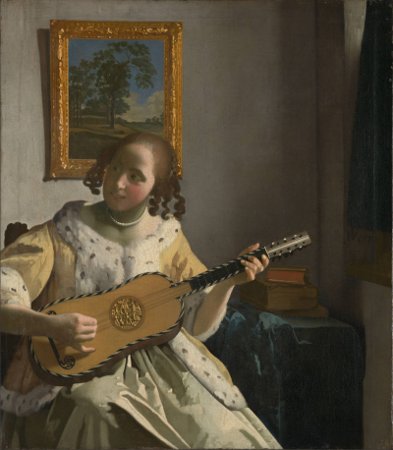
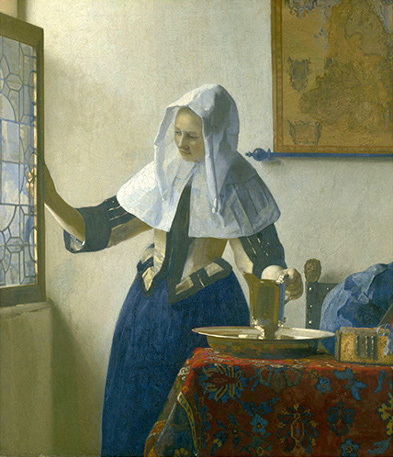
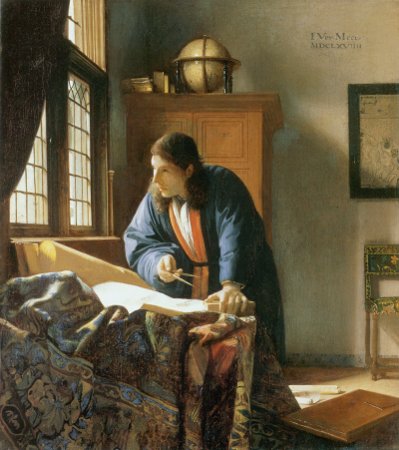
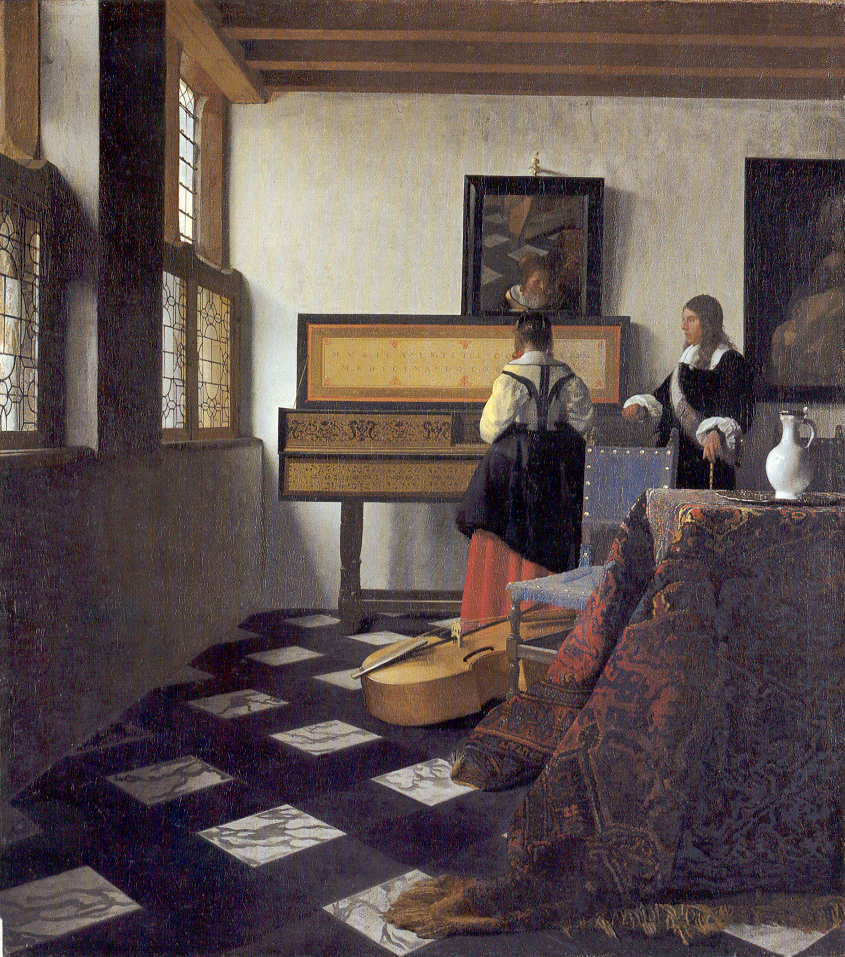
The Vermeer you (probably) don't know


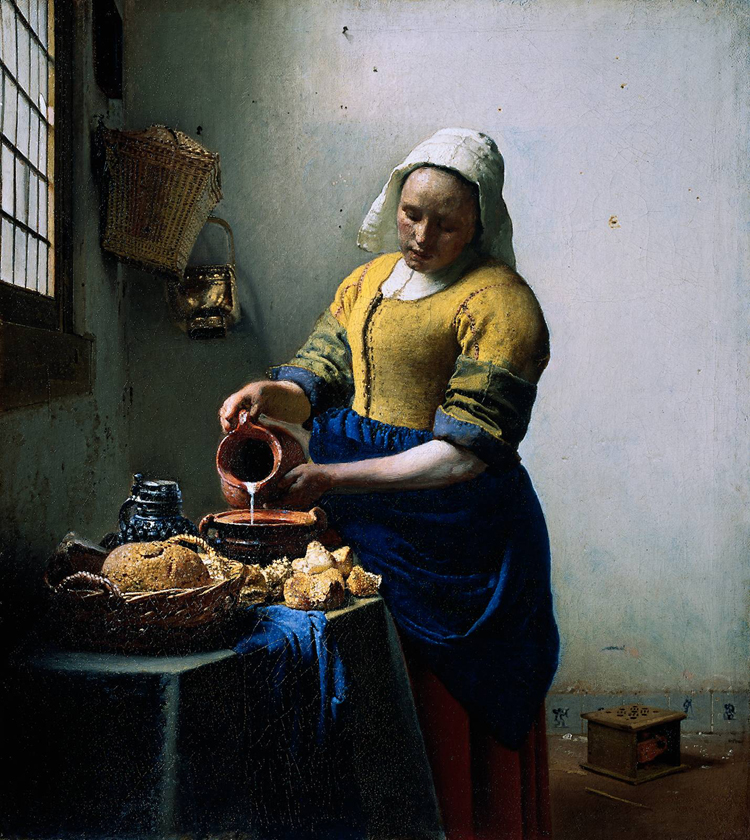
The entire known work of Johannes Vermeer fits on one not-too-long screen on the front page of the website that catalogs his work. Experts generally agree that 34 paintings are his, and there are a couple more possibilities.

Which makes Bob Raczka's in-depth look at seven of them in The Vermeer Interviews a pretty thorough introduction. If you're not familiar with anything beyond the uber-famous Girl With a Pearl Earring, add this book to your list.

Raczka doesn't talk about the paintings as much as he talks to them, and to their subjects. The book is organized as a series of interviews with the milkmaid, the music student, the geographer, and their compatriots.

The interviews bring out technical details about the paintings - the use of light and dark, the possibility that Vermeer used a camera obscura, the fact that scholars have identified the map and globe featured in The Geographer - and speculate on what, precisely, is depicted. (Is Anton van Leewenhoek the model for some of the paintings? Does finding that possibility intriguing mark me as a nerd once again?)

(YA tie-in: The Concert, a Vermeer painting not included in the book, was one of the works taken in the 1990 Gardner heist. So if you're looking for a non-fiction book to pick up after Heist Society has stoked your interest in the history of art theft, try this one.)

The Vermeer Interviews was a Cybils MG/YA non-fiction nominee. The review copy was provided by the publisher.

Thursday, January 7, 2010

Whatever this "mixed media" is, I like it

Alas, neither Candlewick nor Walker Books, which published the UK edition of The Time Book, has made any images of the interior pages available, so you're going to have to be satisfied with the cover as a sample of Richard Holland's artwork. (Click the image to see the really high-res version.)

The illustrations, you see, are what make this book work. They're described in the front matter as "mixed media," and in this case it appears to mean Victorian-style collage with a sense of humor.

The text isn't too shabby either (although it has no references whatsoever - no bibliography, no further reading, and definitely no citations). This isn't A Brief History of Time Young Readers' Edition, it's an overview of timekeeping systems in different cultures - and species - and the difficulties of making it fit into any sort of orderly calendar.

And if you finish reading this and find you want a floral clock of your own - well, blame Martin Jenkins and Richard Holland - and Carolus Linnaeus - not me.

The Time Book was a Cybils nominee for MG/YA non-fiction. Review copy provided by publisher.

Wednesday, June 10, 2009

Trixie continued: happy families are all alike


It's been a long time since my last Trixie post - nearly a year.

Conveniently, our intrepid sleuth pretty much covers everything you need to know on the first page of the second book in the series, The Red Trailer Mystery.
"We're going on a trailer trip, Honey Wheeler and I, with her governess, Miss Trask, to try and find Jim Frayne, who has run away again."
What? You want more?
"Oh, Dad, Jim is really the most wonderful boy I ever knew. His ambition in life is to own and run a camp for orphan boys so they can learn how to be good at sports and how to get along in the woods at the same time that they have school lessons. So that's why we feel sure he's trying now to get a job at one of those three big camps upstate. He could be a junior counselor, like Brian and Mart, or junior athletic instructor, because he's very good at everything and he knows all about the woods and did two years of high school in one and one a scholarship to college --"
That's right, Trix. Time for a breath. (Come on, aren't you a little in love with him too by now?)

So Honey, Trixie, and Miss Trask are headed for the nebulous region known as "upstate" to those of us who live near the coast.

And how are they getting there? In a trailer, featuring a "combination living room and bedroom with a cozy little dining alcove... tiled kitchenette... glistening modern bathroom [e]quipped with a glassed-in shower, fluorescent lighting, and a compact mirrored cabinet over the washbasin."

You think that sounds like fun? Try it for a few days. Rainy ones. When one of the members of your party is a toddler suffering from severe poison ivy. And the thing leaks.

Sorry, forgot whose story we were focusing on here. Back to Trixie, who runs into another mystery, in the form of the trailer they park next to on their first night:
"That's funny," Trixie wondered aloud. "What's a man who looks so poverty-stricken doing in such a lavish trailer?"
Naturally, we find out by the end of the book. And all his problems get solved too.

In the meantime, we get to see familiar themes resurface:
  • Honey is rich.
"It must be an awful nuisance being rich... Your parents are always worrying for fear you'll be kidnapped and held for ransom, aren't they?"
  • Honey fails to display the intelligence she has in the later books.
"Why, he could go to a hotel, couldn't he?" Honey demanded.

Trixie shook her head. "Not without arousing suspicion. Boys his age don't go around stopping at hotels."

"I never thought about that," Honey said slowly.
  • Bad guys are bad from their first lines.
"It was all your fault. You weren't watching where you were going. You'll have to pay for the damage, you stupid little fool!"
  • Bad guys use a lot of slang.
"'You'd better watch who you call a numbskull around here,' Jeff said evenly. 'And in case you're interested, I'm getting fed up with you giving all the orders. This is a fifty-fifty racket, see?'"
  • So do police - state troopers, in this case.
"'Reach for the ceiling, brother... Put your dainty wrists in these bracelets, bud. Pretty, aren't they?... Since we caught these two birds red-handed, we won't need to call you as witnesses."
(This, by the way, marks the first appearance of "dainty wrists" and "bracelets" as a synonym for handcuffs. It will not be the last.)

And of course the book is full of delightful signs of 1950 - airmail letters and telegrams, camps full of husky, energetic boys, a camp called Autoville...

It's not really spoiling anything to say that the book has a happy ending.

Forget spoilers. The book is almost sixty years old, and if you haven't gotten to it yet, it's not my fault.

And anyway, the last page provides us with one more swoon-worthy Jim moment, so naturally I'll close with it here.
"'They're waiting for you at a table inside.' Jim gave her a little push. 'In you go, kid. I'm top man around here now.'"
What? I'm the only one who finds that adorable? Hmph. Just wait for book #3, where Jim gets to confront his first hardened criminal.

Wednesday, May 13, 2009

Anthropology and The Chosen One

The Chosen One, Carol Lynch Williams. 2009.

Because I try to avoid "after hoc therefore something else hoc" fallacies, I'm not going to tell you that The Chosen One is responsible for the bad dreams I had after I read it.

But still.

I'm just sayin'.

If this book were a Feministe post, it would come with "trigger warning" at the top. This is a disturbing story, but it's also one that grabs hold of you.

Kyra is thirteen, and she's about to be married off to her uncle, who already has far more wives than is good for him. But this is an isolated polygamist community, and Kyra's uncle is one of the more powerful men, so she doesn't get much say.

She tries to resist. And she gets some support at home, especially from her father. He's the one who stands to lose the most by Kyra's resistance, and Carol Lynch Williams does a great job showing his internal dilemma - how long can his daughter's interests come ahead of his own?

An Edible History of Humanity isn't the first book you'd link this to, not like The Rapture of Canaan or Lucy Peale, but give me a chance: One of the ideas Tom Standage touches on is the relationship between agriculture and hierarchical societies. The theory is that as people switched from hunting and gathering to agriculture, they became sedentary and acquired possessions that they wanted to hold onto, so they weren't as likely to get up and relocate when a new leader claimed power or new privileges - and eventually we got monarchies and dictatorships.

Think about that as you read Kyra's descriptions of how the community has changed, and think about why even her father can't do much to help.

Other reviews and discussion:
Becky's Book Reviews (plus an author interview)
The Brain Lair
A Chair, A Fireplace & a Tea Cozy
The Stories of a Girl
YA Authors Cafe (author interview)
Cynsations (author interview)

Wednesday, April 22, 2009

Fortuitous Reading

Okay, there are a lot of reasons why I haven't stopped talking about The Hive over the past few days. It's a great overview of how bees show up in human culture, and you don't need more than a passing interest in apiculture to find it intriguing that people have been able to draw just about any metaphor for sexual politics from the beehive, right? Or why people stopped drinking mead a long time ago?

Come on, it's not just me.

But beyond all the great cultural trivia in The Hive, I love that it connects to so many other books I'm familiar with - two of them in particular.

Bee Wilson - and yes, she notes the irony of her name and choice of topic - spends some time on the amazing work done by Francois Huber and Francois Burnens. Huber was blind and Burnens was a peasant who lucked into some education, but between the two of them they turned out some pretty impressive observations on things like the queen's nuptial flight. And they were the subject of Sara George's The Beekeeper's Pupil, which I picked up back in college.

And if I hadn't already been half in love with The Hive, this bit from the last chapter would have done it:
Like everything else about Holmes's life, his elderly vocation as beekeeper has attracted keen debate... Where in the Sussex Downs did Holmes base his apiary? When was he there? Could he have joined forces with a young female apprentice to fight crime in the area?
Is that a namecheck of Mary Russell? Very nearly. Am I looking forward to reading The Language of Bees a second time before its official release date (and then seeing the author in Westport next weekend)? Oh, yes.

Sunday, February 15, 2009

Fire

Fire, by Kristin Cashore. Coming from Dial Young Readers* in September!

There's no way I can talk about Fire without giving away Graceling spoilers. So I'm borrowing from the blog of the author herself, and dropping in a picture - in this case, one of Walden Pond.

(Which Mr. Thoreau probably would not be too impressed with if he were to drop by today. It's not even a good place to walk deliberately. The path around the pond is about two feet wide, with rusty fencing on either side, so you have to do a bit of squeezing and jockeying whenever you come across another walker.)


Are all the no-spoilers people gone? Good.

The actual overlap between the two books is pretty minor - the boy Leck is introduced at the beginning, and he plays a minor role in the plot. We never get to learn why Leck is such a terrible person - and maybe it's one of those things that just is - but we get to see that it's been part of his character from the start.

Fire takes place in the Dells, adjacent to the kingdoms introduced in Graceling. There are no Graces here, but there is one person with superhuman abilities.

If it's hard to imagine a woman more prickly than Katsa, well, meet Fire. She's a human monster, which means she's just that much more captivating than a normal human - whether she wants to be or not - and has the ability to sense and influence minds.

Fire is the only remaining human monster, thanks to her father's death - at which everyone in the Dells heaved a (brief) sigh of relief. She has no interest in mixing with the rest of the world, and spends her days in the company of her friend-with-benefits Archer and his father Brocker.

But the Dells are in the midst of a civil war, and Fire comes to the attention of King Nash and his brother Prince Brigan, commander of the army - and a thoroughly delectable blend of Mr. Darcy, Mr. Rochester, and Sirius Black.

Like Graceling, Fire is about power - different kinds, different uses, and different masters. If Fire and Katsa ever meet (will this be part of Bitterblue? Please?) they may not become friends, but they'll have a lot to share.

Fire is also very much about sex - as a source of power, a way of exerting power, and an emotionally-charged form of human interaction - no matter how much Fire tries to ignore the emotional aspect**.

When I say that sex is a big part of this book, I don't mean in a graphic sense. It's all offstage, but the repercussions - unequal division of love, illegitimate children, what it means to reproduce - are plot drivers, leaving you with just as many questions as answers.

*Dial, not Harcourt, thanks to an editorial relocation.

**Credit for this line of thinking goes to Mitali Perkins, who raised her own questions about Katsa and Po's relationship, which shaped how I read Fire.

Monday, January 5, 2009

11 Planets


11 Planets. David Aguilar, National Geographic Children's Books, 2008.

It's a geeky thing to admit, but I totally have a soft spot for the Harvard Smithsonian Center for Astrophysics.

Maybe it's because one of my college astronomy professors is married to a researcher there, and she took her students to visit the labs. Whatever the reason, I thought it was pretty cool that David Aguilar, a director at the CfA, is both the writer and illustrator of 11 Planets.

For a man who probably gets most of his images off the pixels of a CCD, Aguilar creates some beautiful drawings. He covers the eleven planets of the title, along with some other highlights of this solar system and a look at the solar systems that have only recently been discovered.

If the title count seems off to you, there's a good chance you went through science class before the International Astronomical Union decided to make everyone's mnemonics obsolete. There are now, according to the IAU, which gets to make the rules for this sort of thing, eight full-fledged planets and three minor ones. The minor planets include the now-demoted Pluto, the large asteroid Ceres, and Eris, which had the even cooler name Xena until the official body decided to weigh in. The name they chose is hardly inappropriate, though: in Greek mythology, Eris' domain is discord.

11 Planets is a Cybils Middle Grade/YA Non-Fiction finalist.

Sunday, January 4, 2009

Science on the Loose


Science on the Loose. Helaine Becker, Maple Tree Press, 2008.

Science on the Loose is a fun book.

I'm not saying that it isn't informative or filled with examples or anything like that - but fundamentally, it's about all the fun you can find in science.

From mini-volcanoes (did I miss something as a kid? I don't remember making one, but this experiment shows up in almost every science book) to testing whether images with eyes make people behave better to pointing out that Nature once ran an article called "Chickens Prefer Beautiful Humans" (apparently chickens are among the more discerning barnyard fowl; an unrelated experiment revealed just how little it takes to make a turkey happy), Science on the Loose is a great introduction to the idea of science as a subject that's simultaneously playful, joyful, and real.

Science on the Loose is a Cybils Middle Grade/YA Non-Fiction nominee.

Lincoln Through the Lens


Lincoln Through the Lens. Martin W. Sandler, Walker Books for Young Readers, 2008.

American political mythology gives John F. Kennedy credit for being the first president to use the power of televised images to sway public opinion. I came away from Lincoln Through the Lens ready to give Abraham Lincoln credit for doing the same with photographic images.

Martin W. Sandler points to Lincoln's deliberately mussed hair in one picture, the country lawyer's way of showing that even in his city clothes, he still knew where his roots were.

Lincoln thought a different photograph had a lot to do with his victory in 1860. In that image he's standing, using his height for added authority. "[Matthew] Brady and the Cooper Union Institute [speech] made me president," he said.

If you're at all into photography, pick up a copy of this book. It's almost as good as having the whole Life Magazine archive to pore over!

Lincoln Through the Lens is a Cybils Middle Grade/YA Non-Fiction finalist.

The Bite of the Mango


The Bite of the Mango. Mariatu Kamara with Susan McClelland, Annick Press, 2008.

I'll be honest: I really didn't want to read this book.

The cover copy left me squirming. Mariatu Kamara, who tells her story with the help of Susan McClelland, lost both hands when she was attacked during Sierra Leone's civil war.

But the story is so well-written and intriguing that I kept going, following Mariatu from the refugee camp to London and Canada, where she eventually relocated.

Go into this book aware of what you're getting into. Not only are the rebel attacks described in detail, but there's also a scene of genital mutilation. (Keep this one in mind when you join Readergirlz in discussing No Laughter Here in February.)

The Bite of the Mango is a Cybils Middle Grade/YA Non-Fiction nominee.

Super Crocs & Monster Wings


Super Crocs & Monster Wings: Modern Animals' Ancient Past. Claire Eamer, Annick Press, 2008.

Super Crocs & Monster Wings had me hooked by the time it offered instructions on "How to Become a Fossil." Because, really, who wants a textbook that sticks to the practical stuff?

Super Crocs looks at the ancestors of contemporary animals like dragonflies, beavers, and ground sloths, and it (metaphorically, of course; the target audience didn't even grow up on Jurassic Park) brings them to life.

Think you understand just how big dragonfly ancestor Meganeura was? Look for the picture of the researcher posed with a life-sized model, and try to imagine that settling on your knee.

There's a surprising amount of information packed into this thin paperback, but the presentation isn't overwhelming. Call-outs, photos, and artists' renderings, all in full color, break up the page without disturbing the flow of the text.

Super Crocs & Monster Wings is a 2008 Cybils Middle Grade/YA Non-Fiction nominee.

Sunday, December 14, 2008

Tidbits

I managed to cross off a few more titles on the Cybils list, but it still feels like a long way to go. (In a good way, though! Lots of books I might not have gotten to otherwise.)

There are tons of reviews I'd like to post, but I haven't quite figured out when that's going to happen. For now, here's my endorsement of Jo Walton's Farthing: It resulted in an unplanned trip to Harlem.

(I was reading it on the subway. Between being engrossed in the book and ignoring the announcements because the PA system was pretty poor, I didn't realize the train turned into an express after 59th Street.)

Monday, October 27, 2008

Secret Keeper


I may need to create a new tag in LibraryThing: "made me long for an excuse to wear one of my salwar kameezes."

Secret Keeper definitely qualifies.

Asha would be happy to step into my jeans. She's sixteen in 1974, and would like to be playing cricket or studying for university - she has every intention of becoming the first female Bengali psychologist. But faced with a shortage of engineering jobs in India, Asha's father leaves his family behind while he looks for opportunities in the United States.

Asha, her mother, and her sister move into paternal grandmother's house in Calcutta. There's no money for school fees, and the Gupta adults aren't about to allow Asha to play sports outside the garden, so she finds refuge in her diary - her Secret Keeper - on the roof.

There are no villains in this book. There's no shortage of conflict, but, for example, Grandmother isn't a tradition-bound dragon lady. Asha frequently finds her strict, but she takes her granddaughters' side when it's appropriate.

Secret Keeper is filled with funny lines that jump out of the text (really, would the Grimms care if someone Indianized their tales?) and very nearly tear-inducing at the end - which did not turn out the way I expected.

And I'll admit it, I came away just a little bit in love with Asha's cousin Raj. If he gets to come back in a future book, Mitali, I certainly won't complain.

Secret Keeper by Mitali Perkins. Random House, January 2009.

Monday, October 13, 2008

Hip Hop Speaks to Children

A lot of excellent bloggers have been more timely than me in reviewing this book. See what TheHappyNappyBookseller, HipWriterMama, Fuse #8, Kelly Fineman, Shelf Elf, and Franki have to say about it.

But I still have to have my say. Because it's just that good.

(Actually, this book had me from the introduction, where Nikki Giovanni suggested that "if we could get to Mars we'd probably find a group of young Martians, hats flipped back, pants on the baggy side, shirts down to the knees, busting some rhymes, challenging each other in free style.")

Nikki Giovanni's selections go beyond what we usually think of as hip hop: Paul Lawrence Dunbar, Lucille Clifton, and Langston Hughes make appearances. So does Martin Luther King, Jr.'s prose.

But it works. All the selections in the book have a beat, and they just beg to be read out loud.

The illustrations, done by five different artists, tie in nicely with the poems they represent. While the samples available on Sourcebooks' site are nice, they left out my favorites. When you get your hands on a copy, be sure to check out the illustrations for
  • Dream Boogie (Langston Hughes)
  • Oh, Words (Eloise Greenfield)
  • Principal's Office (Young MC)
  • Harlem Night Song (Langston Hughes)
  • Ego Tripping (Nikki Giovanni)
And there's a CD, too - some of the poets read their own works, some are performed by others. Definitely worth a look!