Showing posts with label living history. Show all posts

Monday, April 28, 2008

More about that picture


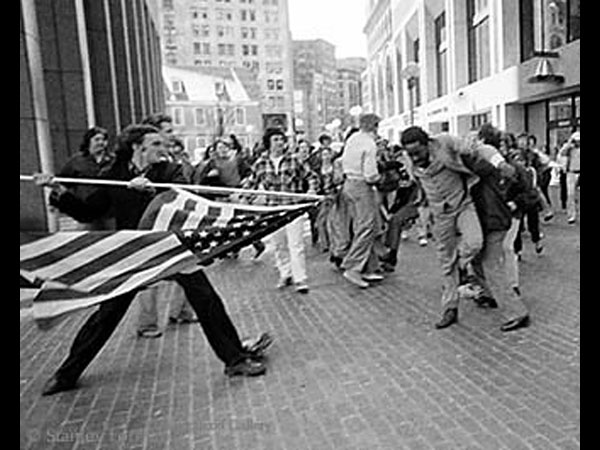
I should have read more closely when I linked to Slate's slideshow on Stanley Forman's photo taken during one of the Boston busing confrontations. The slideshow was put together by Louis Masur, and if I'd made it all the way to the author bio (Slate, one of these days we're going to have a talk about your layout) I'd have seen that Masur has just written a book on the image.

Louis Bayard reviews The Soiling of Old Glory for Salon. The rest of Forman's roll of film apparently tells a more nuanced story.

Thursday, April 10, 2008

Iconic photos

Slate has a photo-essay around one of Stanley Forman's images from the Boston school integration battles. There's a bit of backstory - how many people win a Pulitzer because they showed up late? - context, and comparison to other famous images.

(I love Google. I've just learned that Forman's third Pulitzer, shared with other staff photographers, was awarded for coverage of the blizzard of 1978. Sounds like the perfect complement to a review of My Latest Grievance.)

Saturday, February 2, 2008

Lessons in storytelling

My iPod battery ran out on the way to work yesterday, so I had one of my rare days of listening to live radio on the commute.

I was fortunate enough to hear an absolutely amazing piece on All Things Considered. Michele Norris interviewed Franklin McCain, one of the four students who initiated the sit-in at a Woolworth's lunch counter on February 1, 1960.

"Interview" isn't an accurate description of this piece - Norris asked one or two questions initially, and McCain took it from there, making it more of a narrative than a Q&A.

McCain has an accent that's almost closer to Down East Maine (think Spitfire Grill) than Deep South.

Besides that, he has an incredible way with words. He described the "natural high" that came fifteen seconds after sitting down on the stool: "a feeling of liberation, restored manhood."

And the man knows how to tell a story. This isn't just a reminiscence about one of the seminal moments in civil rights history, it's also a realization that McCain had his own prejudices that day - and how he responded.

(Side note: I'm curious about the editing that went into this piece - was Norris' conversation with McCain initially more of a dialogue, or did McCain tell his story without interruption?