Wednesday, January 25, 2012

Chapter 4: Family dynamics, oh, my!


The chapter opens with Rachel heading off to take some food to a neighbor in need -- which, Judith explains, means she's going to do all the neighbor's housework too.

Needless to say, Judith is not a big supporter of her mother's charitable habits. Mercy, on the other hand, thinks it makes perfect sense. And besides, there's work to be done.

But wait! First, there are dresses.

Judith convinces Kit to open her trunks and show off some of the fashions she brought from Barbados. There's still no real affection between these two, but they're teenage girls, so clothes are sort of a universal language.

It is, unfortunately, a language not spoken by most fathers -- including Matthew.
"Her uncle regarded her with scorn. 'No one in my family has any use for such frippery,' he said coldly. 'Nor are we beholden to anyone's charity for our clothing.'"
But Kit does manage to score half a point -- or maybe just a quarter of one -- by convincing Matthew to let her give Mercy a very plain wool shawl. And a bit of authorial hand-waving alerts us to the fact that Mercy is pretty much the hub of the Wood family.
"Very well. Mercy may keep the shawl."
And then Kit's score goes deep into negative territory, because her question, when the rest of the family starts talking about the chores that have to get done, is, "Don't the servants do that?"

Setting aside slightly contentious aspects of using "servant" in a New England setting, 1 the answer to that is a big no. So Kit learns to work.

There's carding to be done, for one thing. And as much as Kit totally despises it, we've got Mercy's placid acceptance of the task to serve as a counterpoint.
"How dreary it must be for her, working here day after day. Kit was ashamed of her own impatience."
Also, there's scrubbing and cooking and more fun stuff ahead. But putting Kit and Mercy together at a sedentary activity gives Speare a chance to build up a bit more backstory. Here we get to learn more about why exactly Kit left Barbados, and the man she had the opportunity to marry:
"He was very kind. But Mercy, he was fifty years old, and he had pudgy red fingers with too many rings on them."
Willing to basically buy a wife? Okay. But unattractive hands are a deal-breaker.

In the course of heading up to bed that night, Kit overhears a bit of a conversation that introduces another aspect of the Wood family's dysfunctions:
"Yes, a boy would have been different, that's true. Poor Matthew!"
For my part, I think this makes the Kit's-not-a-boy thing sound like a much bigger deal than it actually turns out to be -- it's really never a factor in the plot. But we'll return to it in a future chapter, for a bit more background information.

One other thing to mention at the end of this chapter. Speare is not noted for her sensitive treatment of native characters in her books (see Debbie Reese's blog if you require an explanation), and although there are no native characters in The Witch of Blackbird Pond, we do get several mentions of them. The first one is here.
"The long eerie noise sounded again. Indians?"


1 Setting it aside mainly because I'm not sure whether it applies to the early colonial period, when there was a much closer connection to the English class structure. But in the late colonial/early Federal periods, free-born white Americans did not want to think of themselves as servants. Bill Bryson cites one instance of a maid explaining to a foreign visitor that she was her employer's "help," not his servant, and Fanny Trollope totally goes off on the servant question in Domestic Manners of the Americans. (Which book deserves its own post -- there was a serious bite in that woman's prose!)

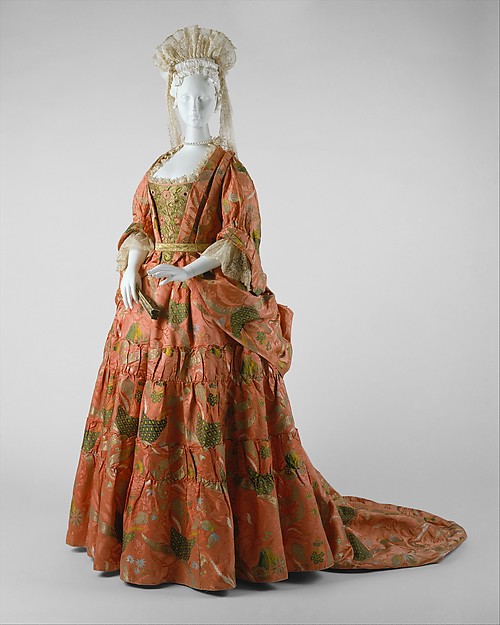
(Post pic: Cheating a little, since this dress is from about twenty years after the book is set; courtesy of the Metropolitan Museum of Art's amazing collection database.)

Wednesday, January 18, 2012

Chapter 3: Culture Shock Continues

Kit is just now realizing that things in Wethersfield really aren't going to live up to her expectations. And if the descriptions of dirt roads and dewy expanses of grass don't get that across, Speare throws in this gem:
"Along with her pretty shoes, Kit's spirits sank lower at each step."
Unsurprisingly, Kit is not happy about this. She's also not thrilled with the pretensions of this little village that claims to have real streets and everything. Anyone who's grown up in cosmopolitan Barbados knows better.
"High Street indeed! No more than a cow path!"
You can just imagine what a Londoner would have been thinking.

Captain Eaton and his men unload Kit's trunks once they've confirmed that this is, in fact, the right house, and they head bad to the Dolphin. And for anyone who doesn't already suspect that we're going to be seeing more of Nat Eaton, Speare makes it obvious that there's unfinished business here.
"As their eyes met, something flashed between them, a question that was suddenly weighted with regret. But the instant was gone before she could grasp it, and the mocking light had sprung again into his eyes."
But now the source of interpersonal conflict shifts as we meet Kit's relatives. There's Uncle Matthew, with his "tall angular body" and prototypical Puritan austerity, and Aunt Rachel, a faded and tired version of the woman Kit imagined. And the cousins, Judith ("this girl could have been the toast of a regiment!" -- alas, I neglected to count how often this phrase or a variation is used, but trust me, it's a lot) and Mercy (whose limp is described as "grotesque," but who is of course strong and sweet and the first person to make Kit feel a little bit welcome).

Kit's not looking forward to explaining her unannounced arrival to Matthew, who's clearly the head of the family, but when he notices that she's brought seven trunks ("The whole town will be talking about it by nightfall.") with her, the truth emerges:
"'I have not come for a visit, sir,' she answered. 'I have come to stay with you.'"
And the details follow: Kit's grown up rich, but when her grandfather died, there were financial irregularities (not his fault, of course) and debts that more or less equaled the value of his estate.

Kit notices that Matthew does seem to appreciate the fact that she made sure all the debts were paid before she left Barbados, but she doesn't think he quite gets what a change it was -- after all, she had to sell her personal slave to pay for her passage, and no one in the Wood household seems to care.

You know how writers are advised to put the main character in a bad situation, and then make it worse? In the next chapter we'll see Speare doing just that.

Saturday, January 14, 2012

Tidbit: Scarlet

Scarlet, A.C. Gaughen. (Bloomsbury, 2/14/2012)

I kind of, sort of, virtually-know the author (we both worked on the Kids Heart Authors project a few years back), so that's what initially drew me to the book. But the premise should do it, too: Robin Hood's colleague Will Scarlet was actually a woman. This is perfect for fans of Katsa and Fire who need something to tide them over until Bitterblue's pub date. Scar totally fits into the emotionally-damaged-but-physically-tough-heroine mode, and I mean that in a good way. And best of all? This is straight-up historical fiction, with no fantasy bits thrown in.

(Review copy provided by publisher.)

Friday, January 13, 2012

Tidbit: Quiet

Quiet: The Power of Introverts in a World That Can't Stop Talking, Susan Cain. (Crown, 1/24/2012)

I don't often get excited about business books, but I'm so glad a Random House sales rep pushed this one into my pile at NEIBA. Fellow introverts, you will join me in realizing why you do stuff (not just the obvious "prefer to be alone" things, but more subtle aspects of behavior) every time Cain throws out a new piece of research. Some of the evolutionary psych aspects of introversion are pretty fascinating, too.

(Review copy provided by publisher, obviously.)

Thursday, January 12, 2012

Tidbit: Mysterious Bones


Mysterious Bones: The Story of Kennewick Man, Katherine Kirkpatrick. (Holiday House, 5/1/2011)

Lots of anthropology-nerd appeal here in this very balanced account of the saga of the human remains known as Kennewick Man. Kirkpatrick never sides with the scientists who wanted to study the remains or the local tribes who claimed him as an ancestor, but there's room to make an argument for either.

(Review copy provided by publisher.)

Wednesday, January 11, 2012

Tidbit: The Mighty Miss Malone

The Mighty Miss Malone, Christopher Paul Curtis. (Wendy Lamb, 1/10/2012)

If you know your children's books, I shouldn't have to say anything more than "Christopher Paul Curtis" to sell this one. But in case you're longing to be convinced: It's not a sequel to Bud, Not Buddy, but it is a companion book, filling in the story of one of the minor characters. And you will want to fight for Miss Deza Malone just as hard as she fights for herself. Curtis walks a fine line, considering his characters are dealing with both racial prejudice and the Great Depression, but Deza's world is never so bleak you can't imagine her succeeding.

(Review copy provided by publisher.)

Chapter 2: Kit learns about New Englanders, Part I

Kit is incredibly bored in this chapter. The Dolphin spends nine days getting from Saybrook to Wethersfield, a distance roughly equal to how far current Connecticut residents will drive to get to a mall.

But this is the second chapter of the book, so the reader's not allowed to be bored or worn out by the whole "are we there yet" thing. So we get occasional bouts of her frustration -- and the sailors' lack of it -- mixed with character development and further spinning of plot threads.

The Cruffs aren't speaking to Kit (which, when you think about what a small space they were occupying, is a pretty impressive feat), but she's got an eye on them, and she doesn't like what she sees.
"Once or twice she had seen the father furtively slip child an extra morsel from his but he was plainly too spineless to stand up for her against shrew of a wife."
She's also got her eye on John Holbrook
"There he sat, hour after hour, so intent that often his lips moved, and two spots of color burned in his pale cheeks, as though some secret excitement sprang from the pages."
but there's a different kind of interest there.
"Kit would make sure that his eyes, blinking half blindly from his book, would focus on her gay, silk-clad figure nearby."
Eventually Kit decides that John is the victim of "an appallingly dull history," but as he's the only person on the ship who's willing to hang out with her, they strike up a friendship of sorts. Their conversation is essentially an ongoing culture clash. Kit is surprised John talks openly about his inability to afford Harvard tuition (though we get a hint of Kit's own money issues there), and John is scandalized that Kit's extensive reading has consisted almost entirely of books Puritans disapprove of. "There are no such books in Saybrook," he tells her.

These conversations also give Speare a chance to throw in some backstory, as Kit shares what she knows of the aunt she's on her way to live with.
"Her name is Rachel, and she was charming and gay, and they said she could have had her pick of any man in her father's regiment. But instead she fell in love with a Puritan and ran away to America without her father's blessing."
To which John suggests that, well, things are different in the colonies: "Kit was aware again of that intangible warning she could not interpret."

Returning for a moment to the subject of people avoiding each other on the ship: Nat Eaton is absent for all Kit's conversations with John, but eventually he decides to chat with her again -- which is not a success.

Kit complains about the lingering smell of horses, a reminder of the ship's previous cargo. Nat not only objects to any sort of criticism of the Dolphin, he also points out that the the alternative cargo was slaves, which he and his father aren't going to touch.
"Yes, to our shame! Mostly down Virginia way. But there are plenty of fine folk like you here in New England who'll pay a fat price for black flesh without asking any questions about how it got here. If my father would consent to bring back just one load of slaves we would have had our new ketch by this summer. But we Eatons, we're almighty proud that our ship has a good honest stink of horses!"
This is the first mention of Kit's attitude toward slavery, something that's going to appear several more times -- and it's an issue that's never actually dealt with over the course of the story.

And then they're in Wethersfield. Which, after all Kit's anticipation, is about what the reader expects:
"This was Wethersfield! Just a narrow sandy stretch of shoreline, a few piles sunk in the river with rough planking for a platform."
But there's a bigger problem, one that only emerges when Captain Eaton wonders why Kit's relatives haven't come to meet the ship: This whole moving-in-with-the-family thing wasn't actually a mutual decision. The Wood family has no idea their niece has left Barbados.

The captain's not too happy about this, grumbling about how he takes no responsibility for her. But Kit's bigger concern, as the captain drafts some of his men to carry her seven trunks to her uncle's house, is this:
"Why should Nat, who had carefully been somewhere else during the whole of the last nine days, have to be so handy at just this moment?"