Monday, August 6, 2012

Holmes Project: The Adventure of Charles Augustus Milverton

Conan Doyle opens this story with one of his efforts to make it look like this is something that really happened. To wit:
"The reader will excuse me if I conceal the date or any other fact by which he might trace the actual occurrence."
Duly noted, Dr. Watson.

"Charles Augustus Milverton" is unusual in that there's not much of a mystery to solve here. It's more about Holmes' ethical system, and the crimes which he considers beyond the pale.

Holmes is not a fan of the title character, as he makes abundantly clear early on:
"Do you feel a creeping, shrinking sensation, Watson, when you stand before the serpents in the Zoo, and see the slithering, gliding, venomous creatures, with their deadly eyes and wicked, flattened faces? Well, that's how Milverton impresses me."
Yeah, ugh.

Milverton, it turns out, is "the king of all blackmailers," and the only reason Holmes is bothering to notice him at all is that he's been hired to recover some potentially embarrassing letters ("imprudent, Watson, nothing worse") on behalf of the woman who wrote them.

When the gentleman in question turns up at Baker Street, Watson gives the reader a rundown of his appearance, and it's not a flattering portrait:
"There was something of Mr. Pickwick's benevolence in his appearance, marred only by the insincerity of the fixed smile and by the hard glitter of those restless and penetrating eyes."
He's pretty much a caricature of a villain, but let's overlook that a bit, because Conan Doyle gives him some rather good lines. Like this one, suggesting that the woman's friends come up with his ransom as a wedding present:
"this little bundle of letters would give more joy than all the candelabra and butter-dishes in London"
This, of course, doesn't sit well with Holmes, who gives up on negotiations and tries to just take the letters back by force. Milverton points out that this is somewhat ineffective since he's not actually carrying the letters -- he has foresight, this one. And then he leaves.

So Holmes has failed in the negotiations he was hired for, but because he has such an antipathy against blackmailers, he's not giving up. Also, it's an excuse for him to trot out one of his disguises.
"Then, with the gesture of a man who has taken his decision, he sprang to his feet and passed into his bedroom. A little later a rakish young workman, with a goatee beard and a swagger, lit his clay pipe at the lamp before descending into the street."
His plan, as it turns out, is to cajole the necessary information from Milverton's housemaid and then steal the letters from the safe. He's not concerned about things going wrong, but Watson is:
"As a flash of lightning in the night shows up in an instant every detail of a wild landscape, so at one glance I seemed to see every possible result of such an action -- the detection, the capture, the honored career ended in irreparable failure and disgrace, my friend himself lying at the mercy of the odious Milverton."
But after a brief discussion, Watson comes to the conclusion Holmes has already reached:
"it is morally justifiable so long as our object is to take no articles save those which are used for an illegal purpose"
And besides that, it's kind of fun:
"The high object of our mission, the consciousness that it was unselfish and chivalrous, the villainous character of our opponent, all added to the sporting interest of the endeavour."
Well, that settles it.

So Holmes and Watson set off to break into Milverton's safe, but they have to duck into hiding when it turns out Milverton's still up, waiting for an appointment. And then this is where things turn either sublime or absurd, depending on your response to lines like "'It is I,' she said, 'the woman whose life you have ruined.'"

This, of course, is the problem all blackmailers face, though most don't have Holmes and Watson watching from behind a curtain when they're shot by past victims. Holmes figures justice is being served, so he hangs back until the woman's done, burns all the letters in Milverton's safe, and skips off back to Baker Street.

And when the police come around the next morning to get his opinion on recent events, he's not all that inclined to help out:
"'Dear me!' said Holmes. 'What was that?'
He has some fun with the fact that he and Watson managed to leave behind a few traces of their presence, and makes it clear that he's not going to offer any material support to the investigation.

But there's one minor mystery left to clear up in the story, and Holmes spends the last paragraph taking care of that one: Among the portraits of "professional beauties" in a photographer's window, he locates the one of the woman at Milverton's house. Her identity, of course, is never revealed.

Wednesday, July 25, 2012

The trouble with bookmarking

Or, more precisely, the trouble with bookmarking stuff for the blog anywhere outside my blog links folder.

Remember last year's Anne of Green Gables extravaganza?

Turns out I'd found and saved an awesome-looking site, full of all those little details I love to point out. And then since I put it in the wrong folder, it never got worked into my chapter summaries.

So. Go check out http://www.lmm-anne.net/archives/. Enjoy.

Tuesday, July 24, 2012

Links again

Bookselling definitions in search of words -- brilliant.
Just because everyone else has already linked to the six-year-old judging books by their covers doesn't mean I'm going to skip it.
A case before the Supreme Court that hinges on the interpretation of the First Sale Doctrine.
New covers for Octavia E. Butler.
An elaborate and informative Amazon infographic.
Advice for beginning journalists.
Comments. Lots and lots of comments. On the DOJ antitrust settlement.

Monday, July 23, 2012

Holmes Project: The Adventure of Silver Blaze

LinkLet's start with the opening line.
"'I am afraid, Watson, that I shall have to go,' said Holmes, as we sat down together to our breakfast one morning."
On the one hand, we're getting a picture of a happy domestic scene here -- it's not hard to imagine Holmes and Watson calmly decapitating eggs and tucking in to the early edition of the paper. But "Silver Blaze" was published after the Holmes stories had started to take off, so anyone familiar with the characters was likely to understand that "I shall have to go" is the prelude to Holmes taking on a case.

But before getting into the details, Holmes and Watson get themselves onto a train for points southwest, and then Holmes calculates their speed by how quickly the train passes telegraph posts. And then we start into the framing for the backstory -- not the history of the case itself, yet, but the context in which Holmes is going to tell Watson all about it.

First, we have some theoretical context:
"It is one of those cases where the art of the reasoner should be used rather for the sifting of details than for the acquiring of fresh evidence."
Which is, I suppose, a bit of a red herring, as the reasoner does in fact do some evidence-collecting later on.

And then a disclaimer:
"Because I made a blunder, my dear Watson -- which is, I am afraid, a more common occurrence than anyone would think who only knew me through your memoirs."
Disclaimer with a side of "hey, we're fictional characters discussing the works in which we appear."

And finally we get the lead-in to the actual story:
"At least I have got a grip on the essential facts of the case. I shall enumerate them to you, for nothing clears up a case so much as stating it to another person, and I can hardly expect your co-operation if I do not show you the position from which we start."
So we've got Holmes' own justification for a chunk of exposition that's necessary for the reader to know where things are going. A horse has gone missing, just before a race in which he's the favorite, and his trainer was found dead. Several people have been observed doing suspicious things, but none of them really make sense.

In the course of Holmes' monologue, one character is described as "doing a little quiet and genteel book-making in the sporting clubs of London." Isn't that an elegant way to depict a bookie?

There's another eye-catching line when it comes to describing the area they're headed to: "the little town of Tavistock, which lies, like the boss of a shield, in the middle of the huge circle of Dartmoor." (I consider this an appropriate point to insert a plug for Laurie R. King's The Moor. But as much as I love the Mary Russell books, I'm trying to stick with looking at Conan Doyle's writing here.)

Once Holmes and Watson arrive on the scene, we get one of the "Holmes is clearly up to something but we don't yet know what" moments:

"'Excuse me,' said he, turning to Colonel Ross, who had looked at him in some surprise. 'I was day-dreaming.' There was a gleam in his eyes and a suppressed excitement in his manner which convinced me, used as I was to his ways, that his hand was upon a clue, though I could not imagine where he had found it."
There's a lot of concrete detail among the clues, some of which probably had more resonance with Conan Doyle's original audience than it does today. I can't say I've met anyone who smokes "long-cut Cavendish," for instance, and it takes a bit of calculating to translate "Twenty-two guineas is rather heavy for a single costume" into real money. (Decimalization may have eliminated some fun terms for standard amounts of money, but it does make the currency far easier to comprehend.)

Conan Doyle takes a moment here to throw in a lovely descriptive line that fits nicely into the story, even though it has nothing to do with the case itself:
"The sun was beginning to sink behind the stable of Mapleton, and the long, sloping plain in front of us was tinged with gold, deepening into rich, ruddy browns where the faded ferns and brambles caught the evening light. But the glories of the landscape were all wasted upon my companion, who was sunk in the deepest thought."
Holmes is rather more focused on hypotheses, and Conan Doyle gives him another opportunity to explain how detection works:
"We imagined what might have happened, acted upon the supposition, and find ourselves justified."
Oh, and also:
"I follow my own methods, and tell as much or as little as I choose. That is the advantage of being unofficial."
It's also a good plan for a writer, no?

So even though Holmes has everything sorted out, Conan Doyle isn't going to let the reader know what he's thinking. And he gives Holmes a chance to show off, telling Colonel Ross that his missing horse will run in the upcoming race as expected, but the Colonel's just going to have to wait for it.
"'Yes, I have his assurance,' said the Colonel, with a shrug of his shoulders. 'I should prefer to have the horse.'"
And then, as Holmes is about to take his leave without providing any answers, Conan Doyle gives us one of his most famous passages:
"'Is there any other point to which you would wish to draw my attention?'
'To the curious incident of the dog in the night-time.'
'The dog did nothing in the night-time.'
'That was the curious incident,' remarked Sherlock Holmes."
And... scene. Always leave your audience wanting more.

We finally get the explanation four days later, when Holmes and Watson go to see the missing horse run its race. And it does run, even though it looks completely different from the last time it was seen.

And Conan Doyle allows Holmes, in a very arch way, to draw out the resolution of the story even more:
"But there goes the bell, and as I stand to win a little on this next race, I shall defer a lengthy explanation until a more fitting time."
Which he does, very neatly, accounting for lame sheep, dress purchases, and an illicit dye job, as well as the murderer -- who, he explains, was merely acting in self-defense.

(Full text)

Wednesday, July 11, 2012

The Sherlock Holmes project

Because I totally needed a reason to reread all the Holmes stories.

In Maps & Legends, Michael Chabon has an essay about Arthur Conan Doyle's Sherlock Holmes stories (and their universe, and the world of Sherlockians and fanfic and such that they spawned, which is the point of the essay, but not where I'm going here.

One of the things Chabon discusses as he builds to his point is level of Conan Doyle's writing in the stories -- "so much higher than it ever needed to be," he calls it. And it's not just good writing, it's writing that plays with form and narrative and metafiction. (In other words, the way Holmes and Watson know that they're characters within stories that the public is devouring, even as they go about their fictional lives. Let's have this be the last time I get all jargony here.)

So now that I've spent time focusing on Jane Eyre, Anne of Green Gables, The Witch of Blackbird Pond, and the men of Madeleine L'Engle, I think the Holmes stories will be my next big project. (And I do mean big. There are 56 of them, plus the novellas. We'll take it in small doses, shall we?)

First up: The Adventure of the Silver Blaze.

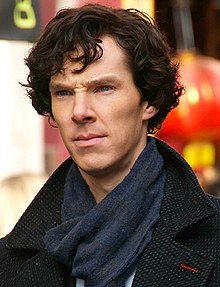
(Post pics: a passing resemblance, don't you think?)

Tuesday, July 10, 2012

Quick links

Monday, July 9, 2012

Words that work

When a piece of writing strikes you as brilliant two days after you finished the book, you know it's doing something right.

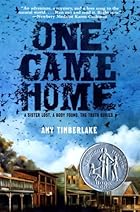
This is from Amy Timberlake's One Came Home.

"I froze. My body did, anyway.

"My mind, on the other hand, jumped over the moon and ran away with the spoon. It listed what it saw by every possible name. It thought the list forward: Catamount, cougar, American lion, painter, red tiger. It thought it backward: Red tiger, painter, American lion, cougar, catamount. My mind pinched the list in the middle, folded it over, an thought it again: Painter, cougar, catamount, red tiger, American lion.

"It distressed me to discover that running vocabulary lists was my mind's behavior during direst need."
(Besides the writing, this book also has some genius cover design on its side. The 1871 migration of passenger pigeons is one of the driving events of the book. Look at the title: Those letters, or at least the edges of them, are a great mass of wild pigeons. Nicely done, David Homer.)