Thursday, March 22, 2012

Chapter 8: New Clothes Solve Everything

Or at least they make the little things better. In this case, Kit gets a new homespun dress that she can actually work in, and Judith starts being almost friendly.

And while that's happening, Kit's first actual friend makes an appearance, though it's at a distance for now. We're given a bit of foreshadowing:
"How often she would come back she had no way of foreseeing, nor could she know that never, in the months to come, would the Meadows break the promise they held for her at this moment, a promise of peace and quietness and of comfort for a troubled heart."
Kit thinks the Meadows are pretty excellent, but Judith points out the practical things, like the fact that it floods on a regular basis, which is why it's the perfect home for the local outcast.
"Nobody but Hannah Tupper would live there by Blackbird Pond."
And Speare points out that everyone loves a good bit of hyperbole. (Spoiler alert: There are no actual witches in this book. But we still get stuck with the imagery.)
"that lonely figure in the ragged flapping shawl - it was easy enough to imagine any sort of mysterious brew in the pot!"
And so to work.
"Kit could never get over her amazement at her cousin. Judith, so proud and uppity, so vain of the curls that fell just so on her shoulder, so finicky about the snowy linen collar that was the only vanity allowed her, kneeling in the dirt doing work that a high-class slave in Barbados would rebel at. What a strange country this was!"
Once again, Kit's attitude toward slavery is totally unexamined. The closest thing we get to breaking it down here is the acknowledgement that she accepts the existence of different classes of slaves, just like we know she's cool with different classes of Englishmen.
"What was she doing here anyway, Sir Francis Tyler's granddaughter, squatting in an onion patch?"
Which is why she starts thinking about the appeal of William Ashby. There's still nothing to write home about in William himself, but Kit knows this is her chance to move back toward the caste she occupied before leaving Barbados.
"Did it seem likely that his mother, who sat so elegantly in meeting, had ever touched a chokeweed? There were no blisters under those soft gloves, Kit wagered. She knew by now that the humble folk who sat in the very back of the Meeting House were servants of the fine families of Wethersfield. William would own servants himself, beyond a doubt."
A) Another indication that Kit's vision of her future includes slave ownership. This is something we'll have to return to in the last chapter. B) Why does no one ever talk about William's father? His mother gets a couple appearances, but Mr. Ashby Senior is mentioned precisely once in the book.

Finally, this chapter ends with some humanizing of Matthew. When Judith is chatty at the beginning of the chapter, she mentions that he's entitled to a bigger plot of land, but doesn't have anyone to help cultivate it. At the end, Mercy provides some context: there were sons, but they didn't make it out of childhood.

So now we see that the Wood family had the potential to be at least a bit better off economically, but the usual way of accumulating wealth through kinship networks (i.e. putting your sons to work for you) is unavailable to them. Plus, now Matthew and Rachel are both, on some level, tragic figures.

Which, as far as Kit's concerned, doesn't make her uncle any less of a grouch, though.

Tuesday, February 28, 2012

Chapter 7: How to Succeed in Romance without Really Trying

From this chapter, I think we can conclude that first dates in colonial times (or mid-twentieth-century depictions thereof) were no less awkward than their present-day counterparts.

Because William has come to call. And as that's about all he's done ("William seemed to feel that merely by coming he had done his share."), Kit's at a loss.
"When a young man came to call what did one talk about? Was it all up to the girl?"
Let me know when you figure that one out, Kit.

Rachel comes to the rescue, essentially giving Kit permission to end the tete-a-tete and join her cousins and John Holbrook, who are about to make popcorn.
"There was something irresistible about popcorn."
Indeed.

When the conversation once again turns to politics, William gets a rare chance to look good, and Kit takes notice:
"William Ashby was neither speechless nor dim-witted. He even dared to stand up to her uncle!"
But that doesn't mean she's starting to think well of him. Judith can't understand why Kit would hesitate.
"Don't you know William is able to build the finest house in Wethersfield if he wants to? Does he have to keep you amused as well?"
If it were me, and if I were going to be living in the house with him, I wouldn't think that a smattering of conversation now and then would be too much to ask.

A month goes by, and William doesn't appear to be hesitating. However, he also doesn't appear to have asked Kit if they're on the same page.
"Without even asking, he was reckoning on her as deliberately as he calculated his growing pile of lumber."
But even though Kit's not thinking warm fuzzy thoughts about William Ashby, she does notice the contrast that he provides to her new daily routine, of which she is not a fan:
"It was incredible that every day should be the same, varied only in the work that filled every hour from sunrise to dark."
Speare-as-narrator gives us a look into Kit's thoughts here, in a way that doesn't exactly present Kit in a good light.
"Her hands were unskillful not so much from inability as from the rebellion that stiffened her fingers. She was Katherine Tyler. She had not been reared to do the work of slaves."
I find the word choice interesting here -- "reared" instead of the more familiar "she had not been born to..." I wonder if that was a deliberate choice.

Also, we've returned once again to Kit's thoughts on slavery: She doesn't question the institution, or her relationship to it. She only objects to the idea that she's being asked to do the same work as the slaves her grandfather used to own.

Monday, February 27, 2012

Chapter 6: Love and Loyalty

That new-post-every-Wednesday thing? Yeah, sorry about that.

To return to the story: This chapter picks up not long after Kit's first church service, continuing our acquaintance with some of the characters introduced there. For instance:
"Reverend Gershom Bulkeley laid down his linen napkin, pushed back his heavy chair from the table, and expanded his straining waistcoat in a satisfied sigh."
Dunno about you, but I get the sense that he's not intended to be a sympathetic character. Especially not when the narrator goes into the list of all the preparations the family's been putting in for the past four days:
"Every inch of the great kitchen had been turned inside out. The floor had been fresh-sanded, the hearthstone polished, the pewter scoured. The brick oven had been heated for two nights in a row, and the whole family had gone without sugar since Sunday to make sure that the minister's notorious sweet tooth would be satisfied."
And then there's this:
"But the greatest part of his condescension he bestowed on Kit, once he had understood that her grandfather had been Sir Francis Tyler."
Speare's doing some signaling here, don't you think? People who appreciate Kit for herself = good. People who see her as a symbol of something = not to be trusted.

We also get a taste of colonial politics here, with Matthew and Bulkeley going at it. Matthew maintains that Kit's loyalty to the Crown "is in no danger in this house," but he also makes his own viewpoint clear:
"There are worse things than revolution!"
(Raise your hand if you get a whiff of Thomas Jefferson there, with his "I like a little rebellion now and then." Everyone with a hand up, your history geek status has been confirmed.)

And in the romance department, we have this development:
"Young William Ashby asked permission today to pay his respects to my niece."
Kit can't imagine why a guy who looked at her for two minutes on Sunday seems to be making a move already. Meanwhile, Judith is just as quick to deny that there was ever anything going on at her end:
"William never asked to call on me. I just said he was getting around to it."
Grain of salt, anyone?

Wednesday, February 8, 2012

Time-shifted narratives


The Ian McKellan production of Richard III is beautiful. (Well, beautiful aside from the scenes of gratuitous violence, but when you're talking about the Wars of the Roses, that's kind of hard to escape.)

What I love about it is that it takes a story written about a specific period of history and, without explanation or even acknowledgement, drops it seamlessly into the 1930s. And it works. For me, it works because:
  • Who cares if cigarettes weren't invented until centuries after Richard III was around? McKellan makes the cigarette (and Richard's difficulties in handling it) as much a part of the character as the hunchback.
  • Oswald Mosley and co. never got their hands on any real power in pre-WWII England, but the idea of a pro-fascist England is both plausible and intriguing (see Jo Walton's Small Change series, for one), and you can't help seeing overtones of it in the movie. This is the 1930s, but the biggest threat to England isn't from Germany, it's from within. Think of it as the dark side of The King's Speech.
  • Did I mention that it's beautiful? The 1930s were a great time for fashion, and the costumes a big part of what makes the movie work. (They were Oscar-nominated, but lost out to Restoration.)

So go, watch it. (Fair warning: I picked this out because I needed a break from Downton Abbey overload -- and then realized that both Maggie Smith and Jim Carter are in it. If you find yourself wondering why Bates is plotting against the king, don't blame me.)

But here's my question: Is there any way this kind of time-shifting could work in a book?

There's a long tradition of moving Shakespeare's works to other eras, even in books. There is no shortage of Romeo and Juliet retellings, or Hamlet-set-in-high-school. And biblical retellings can work in the present day -- Queen of Secrets is one that comes to mind.

But none of those are tied to specific parts of history the way Richard III is. Would it be possible to write the book equivalent of this production, just plopping historical characters down in a different era? Or would it get too caught up in logic, the need to explain away the monarchy's impotence in the 1930s and the simple fact that this wasn't the way it happened?

I haven't been able to think of an example that shows this kind of time-shifting can work in prose, but I'd love to be proven wrong.

Thursday, February 2, 2012

Chapter 5: Religion's first star turn

We've had some intimations that religion is going to be a point of conflict -- Kit and John Holbrook sort of danced around the edges of having an argument, but it's in this chapter, on a "crystal Sabbath morning," that the Puritan issue comes to the front.

Problem #1: Kit doesn't plan to go to church. She has basically grown up as a cultural Anglican, and doesn't get the Puritan mentality. Matthew doesn't give her any leeway on this. She joins the family at church. Which leads to...

Problem #2: Kit's clothes. Which, as we've already established, are far from plain.
"Beside the plain blue homespun and white linen which modestly clothed Aunt Rachel and Judith, Kit's flowered silk gave her the look of some vivid tropical bird lighted by mistake on some strange shore."
She wins this argument, but only because practicality gets in the way of Matthew's principles: there's simply nothing else for her to wear. Kit decides to hold her head high and wear something she knows she looks good in, and Rachel declares that the whole family is proud to be seen with her. Kit doesn't try to fool herself, though: "Judith was certainly not proud of her."

Problem #3: Kit figures that at least she'll get to see the town of Wethersfield now. Clearly they've been hiding the metropolis somewhere. But she steps in it again when she looks at the small wood frame buildings and asks how much farther they have to walk.
"'This is the town,' said Judith stiffly."
Kit is embarrassed, but that doesn't stop her from being underwhelmed.
"There was not a single stone building or shop in sight. The Meeting House stood in the center of the clearing, a square unpainted wooden structure, topped by a small turret."
Problem #3.5: And then we get to see just how sheltered her Barbados upbringing has been:
"Kit recoiled at the objects that stood between her and the Meeting House; a pillory, a whipping post and stocks."
I really doubt Bridgetown lacked its own set. The seventeenth-century penchant for corporal punishment wasn't just a Puritan thing. But Kit, no doubt, was tucked away in her grandfather's house, shielded from unpleasantness like that.

Problem #4: Services last a long time.
"By the time the long psalm was over Kit was glad to sit down, but presently she longed to stand again."
However, this gives Kit a chance to observe her new neighbors. (Of course, Speare never exactly explains how she does this, particularly when it comes to describing the people sitting in the rows behind her, without turning around and drawing attention to herself. Perhaps our third-person narrator is taking a step toward the omniscient, just for a bit.)
"Not all of them shared her uncle's opinions of seemly garb; some were as fashionably dressed as Kit herself. But the majority were soberly and poorly clad, and here and there, in the farthermost pews, Kit glimpsed the familiar black faces that must be slaves."
Again, slavery makes an appearance in the story, and Kit is not in the least troubled by it. And we're going to see more of it.

Even after she gets tired of people-watching, though, she's not giving up.
"Nevertheless, if this were a test of endurance, then she could see it through as well as these New Englanders."
Problem #5: After the service is over, Kit has to actually meet these people.
"A little distance away she glimpsed Goodwife Cruff, surrounded by a close huddle of whispering women, all darting venomous glances in Kit's direction."
She sees John Holbrook again, but is disappointed to see that he's gone totally teacher's pet. Then she meets William Ashby and his mother, and things start looking up.
"Mistress Ashby's dove-colored damask with its gilt-edged lace must have come straight from England."
Well, kind of.
"William was speechless."
Which is another descriptor we're going to see a lot of. However, he's rich, single, and available, so naturally he's the subject of romantic speculation.
"'Have you set your cap for him?' Judith asked bluntly."
...
"Kit colored to the edge of her bonnet. She would never get used to Judith's outspokenness."
Gee, where do you think this bit is headed?

(Post pic: Ridgefield's First Congregational Church. Trust me, it looked like the classic New England white box with steeple until they decided to renovate in the 1880s. Then they went "Italian rustic," or some such thing.)

Wednesday, January 25, 2012

Chapter 4: Family dynamics, oh, my!


The chapter opens with Rachel heading off to take some food to a neighbor in need -- which, Judith explains, means she's going to do all the neighbor's housework too.

Needless to say, Judith is not a big supporter of her mother's charitable habits. Mercy, on the other hand, thinks it makes perfect sense. And besides, there's work to be done.

But wait! First, there are dresses.

Judith convinces Kit to open her trunks and show off some of the fashions she brought from Barbados. There's still no real affection between these two, but they're teenage girls, so clothes are sort of a universal language.

It is, unfortunately, a language not spoken by most fathers -- including Matthew.
"Her uncle regarded her with scorn. 'No one in my family has any use for such frippery,' he said coldly. 'Nor are we beholden to anyone's charity for our clothing.'"
But Kit does manage to score half a point -- or maybe just a quarter of one -- by convincing Matthew to let her give Mercy a very plain wool shawl. And a bit of authorial hand-waving alerts us to the fact that Mercy is pretty much the hub of the Wood family.
"Very well. Mercy may keep the shawl."
And then Kit's score goes deep into negative territory, because her question, when the rest of the family starts talking about the chores that have to get done, is, "Don't the servants do that?"

Setting aside slightly contentious aspects of using "servant" in a New England setting, 1 the answer to that is a big no. So Kit learns to work.

There's carding to be done, for one thing. And as much as Kit totally despises it, we've got Mercy's placid acceptance of the task to serve as a counterpoint.
"How dreary it must be for her, working here day after day. Kit was ashamed of her own impatience."
Also, there's scrubbing and cooking and more fun stuff ahead. But putting Kit and Mercy together at a sedentary activity gives Speare a chance to build up a bit more backstory. Here we get to learn more about why exactly Kit left Barbados, and the man she had the opportunity to marry:
"He was very kind. But Mercy, he was fifty years old, and he had pudgy red fingers with too many rings on them."
Willing to basically buy a wife? Okay. But unattractive hands are a deal-breaker.

In the course of heading up to bed that night, Kit overhears a bit of a conversation that introduces another aspect of the Wood family's dysfunctions:
"Yes, a boy would have been different, that's true. Poor Matthew!"
For my part, I think this makes the Kit's-not-a-boy thing sound like a much bigger deal than it actually turns out to be -- it's really never a factor in the plot. But we'll return to it in a future chapter, for a bit more background information.

One other thing to mention at the end of this chapter. Speare is not noted for her sensitive treatment of native characters in her books (see Debbie Reese's blog if you require an explanation), and although there are no native characters in The Witch of Blackbird Pond, we do get several mentions of them. The first one is here.
"The long eerie noise sounded again. Indians?"


1 Setting it aside mainly because I'm not sure whether it applies to the early colonial period, when there was a much closer connection to the English class structure. But in the late colonial/early Federal periods, free-born white Americans did not want to think of themselves as servants. Bill Bryson cites one instance of a maid explaining to a foreign visitor that she was her employer's "help," not his servant, and Fanny Trollope totally goes off on the servant question in Domestic Manners of the Americans. (Which book deserves its own post -- there was a serious bite in that woman's prose!)

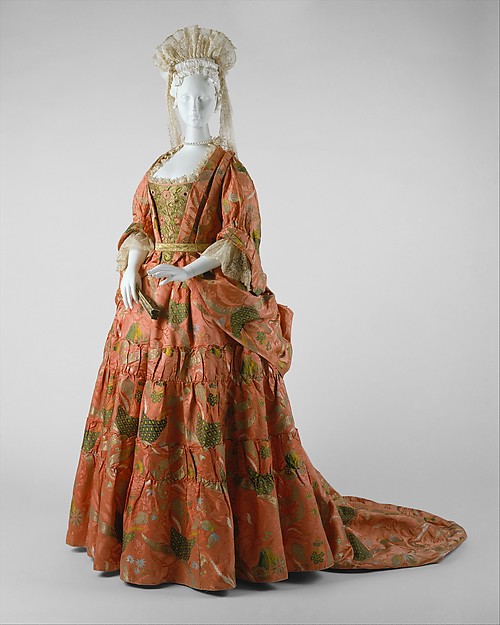
(Post pic: Cheating a little, since this dress is from about twenty years after the book is set; courtesy of the Metropolitan Museum of Art's amazing collection database.)

Wednesday, January 18, 2012

Chapter 3: Culture Shock Continues

Kit is just now realizing that things in Wethersfield really aren't going to live up to her expectations. And if the descriptions of dirt roads and dewy expanses of grass don't get that across, Speare throws in this gem:
"Along with her pretty shoes, Kit's spirits sank lower at each step."
Unsurprisingly, Kit is not happy about this. She's also not thrilled with the pretensions of this little village that claims to have real streets and everything. Anyone who's grown up in cosmopolitan Barbados knows better.
"High Street indeed! No more than a cow path!"
You can just imagine what a Londoner would have been thinking.

Captain Eaton and his men unload Kit's trunks once they've confirmed that this is, in fact, the right house, and they head bad to the Dolphin. And for anyone who doesn't already suspect that we're going to be seeing more of Nat Eaton, Speare makes it obvious that there's unfinished business here.
"As their eyes met, something flashed between them, a question that was suddenly weighted with regret. But the instant was gone before she could grasp it, and the mocking light had sprung again into his eyes."
But now the source of interpersonal conflict shifts as we meet Kit's relatives. There's Uncle Matthew, with his "tall angular body" and prototypical Puritan austerity, and Aunt Rachel, a faded and tired version of the woman Kit imagined. And the cousins, Judith ("this girl could have been the toast of a regiment!" -- alas, I neglected to count how often this phrase or a variation is used, but trust me, it's a lot) and Mercy (whose limp is described as "grotesque," but who is of course strong and sweet and the first person to make Kit feel a little bit welcome).

Kit's not looking forward to explaining her unannounced arrival to Matthew, who's clearly the head of the family, but when he notices that she's brought seven trunks ("The whole town will be talking about it by nightfall.") with her, the truth emerges:
"'I have not come for a visit, sir,' she answered. 'I have come to stay with you.'"
And the details follow: Kit's grown up rich, but when her grandfather died, there were financial irregularities (not his fault, of course) and debts that more or less equaled the value of his estate.

Kit notices that Matthew does seem to appreciate the fact that she made sure all the debts were paid before she left Barbados, but she doesn't think he quite gets what a change it was -- after all, she had to sell her personal slave to pay for her passage, and no one in the Wood household seems to care.

You know how writers are advised to put the main character in a bad situation, and then make it worse? In the next chapter we'll see Speare doing just that.