Saturday, September 12, 2009

Trixie Belden and the Class Snobbery


In Trixie's fourth adventure, The Mysterious Visitor, she delves into the unexplored world of social classes. She learns that there are poor people in Sleepyside. And the nouveaux riches? Well, you just can't expect real warmth or taste.

This book marks the first appearance of Bob-White Diana Lynch, whom Trixie introduces like so:
"Next to you, Honey, she's the prettiest girl in our class. She doesn't get very good marks, but neither do I. She's got two sets of twins for brothers and sisters, and her father made a million dollars a couple of years ago. They have a huge place that's as gorgeous as yours, high on a hill that's even higher than your hill, with a marvelous view of the river."
Aren't those the details you want as soon as you meet someone?

Also:
As a 'surprise' for Diana, he had persuaded Mrs. Lynch to order caterers, a five-piece orchestra, and even decorators from New York.
Diana's bedroom:
It was a decorator's dream of a room, done in royal blue and gold. There were twin beds in it, a huge sofa, two comfortable chairs, a desk, and even a love seat. The gold silk curtains matched the bedspreads, which were monogrammed in royal blue.
But there's a cure for all that, because old money always knows best:
"It's really quite simple," Miss Trask put in. "I'm sure, Honey, that Mrs. Wheeler would like very much to invite Di's parents to the dinner she's giving next Friday night. When she telephones Mrs. Lynch tomorrow morning, she could suggest at the same time that Di's friends would have much more fun if the party Di gives is simply an informal affair."
(Side note: Old money also understands noblesse oblige. The Wheelers are giving a cottage to their soon-to-be-married chauffeur and maid. But it's not just out of altruism:
"If they set up housekeeping in the village, they'll lose their jobs because Dad and Mother have to have a maid and a chauffeur who live on the premises."
Ah, the difficulties of maintaining a country estate.)

Oh, and this:
"Listen, Di," Trixie said seriously, "you've got to stop hating being rich."
And then there's the other side of town, a street Trixie has never heard of until the Wheelers' chauffeur sets her straight:
"Anyway, he says Hawthorne Street is the worst street in town. Most people call it Skid Row. Nothing but ramshackle houses where bums live when they're not in jail."
Our heroine is a little concerned about her foray into this new world. The solution? Dehumanize the residents!
"There's nothing to be afraid of," Trixie said to herself firmly. "This used to be a cowpath once. I'm going to pretend that all these strange-looking people are harmless cows."...

The women, in their bright shawls and full skirts, looked like gypsies, and the men, when they moved at all, shuffled as though their feet hurt. Even the children moved slowly and stared suspiciously at Trixie as she passed by.
And once she moves onto Hawthorne Street itself, in all its underclass glory:
They were no worse than the dilapidated buildings in the alley, but there was something evil about them. The accumulated dirt of years clung to them, and there wasn't a single solitary soul in sight... There were no porches or stoops here.
I don't know what else to say about the rampant class bias. Is it Julie Campbell's perspective, or did she just think it would be appropriate for the characters?

Thus endeth the rant. Let's move onto other details.

No, one more minor rant first. Feel free to count the instances of stupid in the following sentence:
"But he couldn't have been one of the first settlers [of Arizona]. They were mostly killed off by the Indians before the Revolution."
Okay, back to being frivolous. The Mysterious Visitor includes some good bits of dialogue, including this:
"I guess you're right," Trixie said again. "I was just thinking -"

"Don't," Reagan interrupted. "Don't think. Every time you do, this place is swarming with state troopers and G-men."
And this:
Trixie shrugged. "Do you know what 'casing the joint' means, Honey?"
"No, I don't," Honey said crossly.

"You should read more detective stories," Trixie said.
And then there's an exchange that's of interest primarily because it ties into the plot of a Cherry Ames book written by the same author (writing as Julie Tatham):
Jim patted Honey's hand. "You're too young and innocent to understand the nature of shady characters like Olyfant. They make it their business to know all there is to know about rich or famous people like the Lynches."

"I still don't understand," Honey said. "Newspapers and county clerks* don't give information to just anyone, especially not to shady characters."

"But crooked politicians do," Jim said, grinning.

"That's right," Mart said. "I've been looking into Olyfant. He's been arrested dozens of times but never convicted of anything. That spells a crooked political connection in capital letters."
I don't believe we've started keeping track of books in which Trixie gets tied up, so let's consider this Item #1. Like the "bracelets" list, it's going to grow.

*Today, at least, the second half of Honey's assumption is patently false. County clerks and other municipal employees are governed by the state or local version of the Freedom of Information Act. It's an important piece of legislation - even if I did grumble about making copies for FOIA requests back when I worked for a municipal agency.

Saturday, September 5, 2009

According to books read in 2009...

Taken from Educating Alice and many others:

Describe yourself:
Struts and Frets
How do you feel?
Along for the Ride
Describe where you currently live:
The Hive
If you could go anywhere, where would you go?
The Falls
Your favorite form of transport:
The Rock and the River
Your best friend is . . . ?
Impossible
You and your friends are . . .?
Ladies of Liberty
What’s the weather like?
Ice
Favourite time of day?
Shelf Discovery
What is life to you?
The Mostly True Adventures of Homer P. Figg
What is the best advice you have to give?
How to Talk Minnesotan
Thought for the Day?
Alphabet Juice
My soul’s present condition?
The Treasure Map of Boys

Saturday, August 15, 2009

Interview: Christine Marciniak

You want a definition of unputdownable (with apologies to Ann Kingman, who despises that word)? I stood in front of my computer desk for two hours the first time I read When Mike Kissed Emma. The laptop battery had run down, so I had to plug in, but I hadn't gotten around to getting a chair for my desk. And yet I was so engrossed in the story I didn't want to leave it.

Now it's everyone else's turn, because this is When Mike Kissed Emma's launch week. It's Christine Marciniak's debut novel, and she's dropped by here to answer some questions about it.

(Full disclosure: Chris is a member of my critique group, and obviously I'm not an unbiased reader. To see what other people - ones who don't know Chris - have said about When Mike Kissed Emma, check out the reviews on Chris' blog, Simply Put.

What does your writing space look like?

My writing space looks very much like my living room. A couple of years ago I got a laptop computer - since then I've ceded the desktop to the kids and my husband (I used to sit at an actual desk and type). Now I hang out on the sofa, usually with a cup of tea next to me, and work that way.

Who would you cast in the movie of When Mike Kissed Emma?

I'm so not up on who the teen actors are these days. Zac Efron might make a good Mike. I'm kind of lost though on good ideas for Trevor and Emma. Any suggestions?

Are you a performer like Emma?

When I was in elementary and middle school I really enjoyed being on stage and did a few different things, including our Eighth Grade Production, which was a blast. Since then I haven't been on stage, but I did work backstage on a number of high school shows.

(Chris talks about her theatrical history in more detail at Simply Put.)

Have you thought about what comes next for the characters?

I suppose it would be too easy to say that they live happily ever after. I don't know if Mike and Emma are destined to stay together forever. I do know that they are going to have fun getting to really know each other and hang out together at least through high school.

What advice would high school you give Emma?

Emma seems to have it pretty much figured out. One good piece of advice would be: don't worry so much about what your friends think, be true to yourself.

What's your favorite part of The Sound of Music?

My favorite part of the movie is when Maria is singing "I've Got Confidence" as she goes up to the big house. I like how she puts on a brave face and chases away her fears. And also, like Emma, I love the scene where Liesl and Rolf are dancing in the gazebo.

Tuesday, August 11, 2009

The East Cost is really long

That may seem obvious, but I've been driving it - I left Sarasota on Sunday and got home to Connecticut tonight.

If you've been following me on Twitter then you've seen similar brilliant observations from the road. If not, you'll still understand that this is my excuse for not having a post ready for the One Shot Southeast Asia blog tour tomorrow.

So take yourself over to Chasing Ray for the complete list of posts from people who are better about time management (or expectation-setting; I also thought I was going to write 5500 words on this trip) than I am - and then come back here in a few days so I can tell you all about the fab Children of the River.

Monday, July 27, 2009

Change? Not so much.

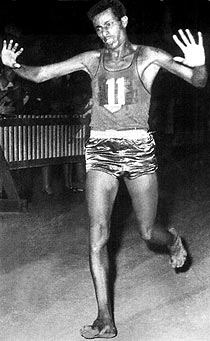
Forty-nine years ago next month, Rafer Johnson became the first African-American to captain the U.S. Olympic team, and the first African-American to carry the flag in the opening ceremonies.

I didn't know that until last week.

Something else I didn't know until last week: Justine Larbalestier protested her publisher's decision to put a long-haired white girl on the cover of Liar even though the protagonist is a short-haired African-American.

Justine lost.

David Maraniss' Rome 1960 - which, by the way, features a black man on the front cover an a black woman on the back - makes it pretty clear that Johnson's prominent position was all about propaganda. Sure, he was a great athlete - he won gold in the decathlon - and he was respected by his teammates, and he was a leader, and the story of the 1960 decathlon pretty much sums up the Olympic ideal - but what really counted with the people in charge was creating the image above.

It was an attempt to drown out Cold War criticism of the ongoing segregation in the U.S. - never mind that Wilma Rudolph and her teammates couldn't stop to use a real bathroom when they traveled to meets back home. And the fact that an American observer wondered what his compatriots would think about a "colored boy" leading the team? An anomaly. The Soviets were telling lies.

At the same time, the International Olympic Committee accepted South Africa's claim that there simply weren't any qualified athletes of color in the country, and that was the reason the South African team was whites-0nly.

It's easy to read about the 1960 Olympics and wonder how much has really changed when the Carl Brandon Society still has to issue open letters like this. It's easy to say the Liar fiasco isn't really a surprise.

But what comes next?

I don't do the buying at my store, and I don't have much influence with the buyers. (I don't even buy all that many books myself, thanks to the whole working-at-a-bookstore thing.)

I can't be a writer of color myself, but I can make a conscious effort to bring attention to writers of color here. I was a Latin American studies major; it's not like I have a shortage of works to draw from.

I can pay attention to the conversation, and take part.

And then we'll see what comes next.(The 1960 Olympic marathon was also the first to be won by an African runner, Abebe Bikila of Ethiopia. He ran the race barefoot because his running shoes were giving him blisters. He won the gold medal again in 1964.)

Friday, July 17, 2009

Writers of color

Borrowing this list from Color Online, via The HappyNappyBookseller. X means read, # means on the TBR list, and ! means loved.

Susan’s Unofficial List of Great YA by or About Women of Color:

1. When Kambia Elaine Flew In From Neptune by Lori A. Williams
2. Every Time A Rainbow Dies by Rita Williams-Garcia
3. No Laughter Here by Rita Williams-Garcia
4. Jumped by Rita Williams-Garcia
5. If You Come Softly by Jacqueline Woodson (X)
6. The House You Pass On The Way by Jacqueline Woodson
7. Flygirl by Sherri L. Smith (#)
8. From The Notebooks of Melanin Sun by Jacqueline Woodson
9. Sold by Patricia McCormick
10. Heaven by An Na
11. The Parable of The Sower by Octavia E. Butler (!)
12. Purple Hibiscus by Chimamanda Ngozi Adichie (#)
13. Persepolis by Majane Satrapi (X)
14. The Rock and The River by Kekla Magoon (!)
15. Secret Keeper by Mitali Perkins (!)
16. Mare’s War by Tanita S. Davis (#)
17. A Wish After Midnight by Zetta Elliott (#)
18. Down To The Bone by Mayra Lazara Dole
19. Don’t Get It Twisted by Paula Chase
20. Jason & Kyra by Dana Davidson (!)
21. Forged by Fire by Sharon Draper
22. Kendra by Coe Booth (!)
23. Shine, Coconut Moon by Neesha Meminger (#)
24. Does My Head Look Big In This? By Randa Abdel-Fattah (X)
25. Born Confused by Tanuja Desai Hidier
26. Skunk Girl by Sheba Karim (X)
27. The Meaning of Conseulo by Judith Ortiz Cofer
28. In The Time of the Butterflies by Julia Alvarez (!)
29. Kindred by Octavia E. Butler (!)
30. First Part Last by Angela Johnson
31. Pemba’s Song by Marilyn Nelson
32. Wanting Mor by Rukhsana Khan
33. M + O 4EVR by Tonya Hegamin (#)
34. Lucy The Giant by Sherri L. Smith
35. The House on Mango Street by Sandra Cisneros (X)
36 Throwaway Piece by Jo Ann Hernandez
37. White Bread Competition by Jo Ann Hernandez
38. Across A Hundred Mountains by Reyna Grande (#)
39. Silver Phoenix by Cindy Pon
40. Ash by Malinda Lo
41. The Skin I’m In by Sharon G. Flake

It's hardly a comprehensive list of the writers of color I've read and loved, let alone my ever-growing TBR list, but it's a start.

Thursday, July 16, 2009

Blog Love

I admit it: I have a blog-crush.

Instead of fluttering my eyelashes and flipping my hair and waiting to see if he noticed me, I keep checking for the next post at the Abbeville Manual of Style. And the latest post is why.

This is what I've wanted to say to all the "but I want my cheap e-books now" complaints, only I hadn't figured out the words:
Let’s be clear, however: even if they are slow to accomplish this, an unchecked spree of digital book piracy will be a failure of law enforcement, not of business innovation. Customers do not have the right to steal goods that they can’t obtain as cheaply or conveniently as they might prefer... You could also have invested in a portable CD player and suffered the inconvenience of carrying a little extra weight, because that was the legal option. You didn’t have to steal music any more than we have to go shoplift from Gristedes right now because their prices aren’t as low as we might like, or because they won’t offer the convenience of, say, delivering groceries to our office this minute.
Personally, I'd like this dress in my size with a zero knocked off the price, but I'm not going to whine about not getting it - and it would be utterly baseless for me to do so.

So mwah, Abbeville. Thanks for being the voice of reason!