
 Forty-nine years ago next month, Rafer Johnson became the first African-American to captain the U.S. Olympic team, and the first African-American to carry the flag in the opening ceremonies.
I didn't know that until last week.
Something else I didn't know until last week: Justine Larbalestier protested her publisher's decision to put a long-haired white girl on the cover of Liar even though the protagonist is a short-haired African-American.
 Justine lost.
David Maraniss' Rome 1960 - which, by the way, features a black man on the front cover an a black woman on the back - makes it pretty clear that Johnson's prominent position was all about propaganda. Sure, he was a great athlete - he won gold in the decathlon - and he was respected by his teammates, and he was a leader, and the story of the 1960 decathlon pretty much sums up the Olympic ideal - but what really counted with the people in charge was creating the image above.
It was an attempt to drown out Cold War criticism of the ongoing segregation in the U.S. - never mind that Wilma Rudolph and her teammates couldn't stop to use a real bathroom when they traveled to meets back home. And the fact that an American observer wondered what his compatriots would think about a "colored boy" leading the team? An anomaly. The Soviets were telling lies.
At the same time, the International Olympic Committee accepted South Africa's claim that there simply weren't any qualified athletes of color in the country, and that was the reason the South African team was whites-0nly.
It's easy to read about the 1960 Olympics and wonder how much has really changed when the Carl Brandon Society still has to issue open letters like this. It's easy to say the Liar fiasco isn't really a surprise.
But what comes next?
I don't do the buying at my store, and I don't have much influence with the buyers. (I don't even buy all that many books myself, thanks to the whole working-at-a-bookstore thing.)
I can't be a writer of color myself, but I can make a conscious effort to bring attention to writers of color here. I was a Latin American studies major; it's not like I have a shortage of works to draw from.
I can pay attention to the conversation, and take part.
And then we'll see what comes next.
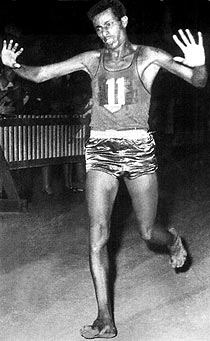 (The 1960 Olympic marathon was also the first to be won by an African runner, Abebe Bikila of Ethiopia. He ran the race barefoot because his running shoes were giving him blisters. He won the gold medal again in 1964.)

