Monday, July 27, 2009

Change? Not so much.

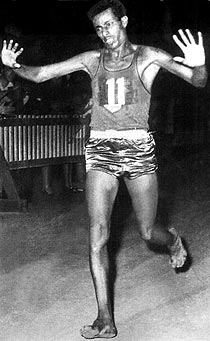
Forty-nine years ago next month, Rafer Johnson became the first African-American to captain the U.S. Olympic team, and the first African-American to carry the flag in the opening ceremonies.

I didn't know that until last week.

Something else I didn't know until last week: Justine Larbalestier protested her publisher's decision to put a long-haired white girl on the cover of Liar even though the protagonist is a short-haired African-American.

Justine lost.

David Maraniss' Rome 1960 - which, by the way, features a black man on the front cover an a black woman on the back - makes it pretty clear that Johnson's prominent position was all about propaganda. Sure, he was a great athlete - he won gold in the decathlon - and he was respected by his teammates, and he was a leader, and the story of the 1960 decathlon pretty much sums up the Olympic ideal - but what really counted with the people in charge was creating the image above.

It was an attempt to drown out Cold War criticism of the ongoing segregation in the U.S. - never mind that Wilma Rudolph and her teammates couldn't stop to use a real bathroom when they traveled to meets back home. And the fact that an American observer wondered what his compatriots would think about a "colored boy" leading the team? An anomaly. The Soviets were telling lies.

At the same time, the International Olympic Committee accepted South Africa's claim that there simply weren't any qualified athletes of color in the country, and that was the reason the South African team was whites-0nly.

It's easy to read about the 1960 Olympics and wonder how much has really changed when the Carl Brandon Society still has to issue open letters like this. It's easy to say the Liar fiasco isn't really a surprise.

But what comes next?

I don't do the buying at my store, and I don't have much influence with the buyers. (I don't even buy all that many books myself, thanks to the whole working-at-a-bookstore thing.)

I can't be a writer of color myself, but I can make a conscious effort to bring attention to writers of color here. I was a Latin American studies major; it's not like I have a shortage of works to draw from.

I can pay attention to the conversation, and take part.

And then we'll see what comes next.(The 1960 Olympic marathon was also the first to be won by an African runner, Abebe Bikila of Ethiopia. He ran the race barefoot because his running shoes were giving him blisters. He won the gold medal again in 1964.)

Friday, July 17, 2009

Writers of color

Borrowing this list from Color Online, via The HappyNappyBookseller. X means read, # means on the TBR list, and ! means loved.

Susan’s Unofficial List of Great YA by or About Women of Color:

1. When Kambia Elaine Flew In From Neptune by Lori A. Williams
2. Every Time A Rainbow Dies by Rita Williams-Garcia
3. No Laughter Here by Rita Williams-Garcia
4. Jumped by Rita Williams-Garcia
5. If You Come Softly by Jacqueline Woodson (X)
6. The House You Pass On The Way by Jacqueline Woodson
7. Flygirl by Sherri L. Smith (#)
8. From The Notebooks of Melanin Sun by Jacqueline Woodson
9. Sold by Patricia McCormick
10. Heaven by An Na
11. The Parable of The Sower by Octavia E. Butler (!)
12. Purple Hibiscus by Chimamanda Ngozi Adichie (#)
13. Persepolis by Majane Satrapi (X)
14. The Rock and The River by Kekla Magoon (!)
15. Secret Keeper by Mitali Perkins (!)
16. Mare’s War by Tanita S. Davis (#)
17. A Wish After Midnight by Zetta Elliott (#)
18. Down To The Bone by Mayra Lazara Dole
19. Don’t Get It Twisted by Paula Chase
20. Jason & Kyra by Dana Davidson (!)
21. Forged by Fire by Sharon Draper
22. Kendra by Coe Booth (!)
23. Shine, Coconut Moon by Neesha Meminger (#)
24. Does My Head Look Big In This? By Randa Abdel-Fattah (X)
25. Born Confused by Tanuja Desai Hidier
26. Skunk Girl by Sheba Karim (X)
27. The Meaning of Conseulo by Judith Ortiz Cofer
28. In The Time of the Butterflies by Julia Alvarez (!)
29. Kindred by Octavia E. Butler (!)
30. First Part Last by Angela Johnson
31. Pemba’s Song by Marilyn Nelson
32. Wanting Mor by Rukhsana Khan
33. M + O 4EVR by Tonya Hegamin (#)
34. Lucy The Giant by Sherri L. Smith
35. The House on Mango Street by Sandra Cisneros (X)
36 Throwaway Piece by Jo Ann Hernandez
37. White Bread Competition by Jo Ann Hernandez
38. Across A Hundred Mountains by Reyna Grande (#)
39. Silver Phoenix by Cindy Pon
40. Ash by Malinda Lo
41. The Skin I’m In by Sharon G. Flake

It's hardly a comprehensive list of the writers of color I've read and loved, let alone my ever-growing TBR list, but it's a start.

Thursday, July 16, 2009

Blog Love

I admit it: I have a blog-crush.

Instead of fluttering my eyelashes and flipping my hair and waiting to see if he noticed me, I keep checking for the next post at the Abbeville Manual of Style. And the latest post is why.

This is what I've wanted to say to all the "but I want my cheap e-books now" complaints, only I hadn't figured out the words:
Let’s be clear, however: even if they are slow to accomplish this, an unchecked spree of digital book piracy will be a failure of law enforcement, not of business innovation. Customers do not have the right to steal goods that they can’t obtain as cheaply or conveniently as they might prefer... You could also have invested in a portable CD player and suffered the inconvenience of carrying a little extra weight, because that was the legal option. You didn’t have to steal music any more than we have to go shoplift from Gristedes right now because their prices aren’t as low as we might like, or because they won’t offer the convenience of, say, delivering groceries to our office this minute.
Personally, I'd like this dress in my size with a zero knocked off the price, but I'm not going to whine about not getting it - and it would be utterly baseless for me to do so.

So mwah, Abbeville. Thanks for being the voice of reason!

Monday, June 15, 2009

Trixie and all the supporting characters

It's summertime in Sleepyside, and the Trixie Belden series really gets underway with book number three.

Summer's a good time for Trixie.
The girls were wearing shorts and tops so that they could take a dip in the lake whenever they wanted to, without bothering to change into swimsuits.
There's swimming! And horses! Oh, and diamonds.

One diamond, actually, found by Trixie and Honey (of course) in the floor of the cottage at the edge of the Manor House grounds.

Honey, having learned how to tell real gems from paste (what else would a millionaire's daughter do?), is ready to hand the diamond over to the police immediately. But the ever-persuasive Trixie has other plans.
"Oh, no, please," Trixie begged. "Let's not tell anybody about it for a little while. Let's try to solve the mystery of how it got in the cottage ourselves."
And why doesn't Trixie want the police involved?
"The cottage would be positively crawling with detectives who'd find all the clues before we had a chance."
Because this is when Trixie discovers her true calling: she's going to be a detective. And Honey too, just as soon as they get through with pesky things like chores and school and older brothers who like to make fun of them.

Yes, brothers. Aside from the detective thing, Brian and Mart Belden's first appearance is what makes The Gatehouse Mystery the first real book in the series. (There's also the fact that I had this one long before I acquired the first two, but I'm sticking with my thesis.)
"The one on the left with the funny-looking crew cut is Mart. The other odd-looking creature is Brian. I hate them both at the moment."
Trixie hates her brothers (at the moment) for the same reason I love them: they provide some much-needed perspective and tranquility, and aren't given to making assumptions like "The reason why the crooks didn't come back for it when they found out it wasn't with all the rest of the loot is that they got killed off in a gang war or something."

You love them too, don't you?

By the way, the Wheelers are rich. Just in case you'd forgotten.

In book #3, that means Honey gets stuck with lines like this:
"Regan's been complaining that, what with having to drive servants back and forth and having such trouble with car repairs, we need a chauffeur. I really think I'm going to have to speak to Daddy about it."
And this one:
"Don't feel so bad. Daddy has plenty of money. He can keep us out of jail... If the police come around asking for diamonds, Mother will give them one of hers."
Oh, and we're treated to a description of casual dining a la Wheeler:
But on Thursdays, the cook's night off, the meal was a much more simple affair. Celia served the first course, and then she and Miss Trask brought in platters of cold cuts and big bowls of salad. Everyone helped himself, and the dessert was usually fruit and crackers with several kinds of cheese. Grown-ups were served coffee in fragile little cups.
(Is it just me, or does anyone else think Maureen O'Hara would be just right as Mrs. Wheeler?)

A few other miscellaneous bits of interest:
  • The Gatehouse Mystery was my introduction to Diamond Jim Brady (the Belden siblings are familiar enough with the name that they can use it as a subtle reference to the gem in question) and the art of forging signatures. The actual forgery instructions weren't so useful, because carbon paper was no longer a household staple by the time I met the book (and it was no longer the case that "anyone can rent a typewriter"), but I still liked knowing how to do it.
  • For everyone keeping count, this is now the second time we've seen "bracelets" for handcuffs, this time courtesy of Jim.

Wednesday, June 10, 2009

Trixie continued: happy families are all alike


It's been a long time since my last Trixie post - nearly a year.

Conveniently, our intrepid sleuth pretty much covers everything you need to know on the first page of the second book in the series, The Red Trailer Mystery.
"We're going on a trailer trip, Honey Wheeler and I, with her governess, Miss Trask, to try and find Jim Frayne, who has run away again."
What? You want more?
"Oh, Dad, Jim is really the most wonderful boy I ever knew. His ambition in life is to own and run a camp for orphan boys so they can learn how to be good at sports and how to get along in the woods at the same time that they have school lessons. So that's why we feel sure he's trying now to get a job at one of those three big camps upstate. He could be a junior counselor, like Brian and Mart, or junior athletic instructor, because he's very good at everything and he knows all about the woods and did two years of high school in one and one a scholarship to college --"
That's right, Trix. Time for a breath. (Come on, aren't you a little in love with him too by now?)

So Honey, Trixie, and Miss Trask are headed for the nebulous region known as "upstate" to those of us who live near the coast.

And how are they getting there? In a trailer, featuring a "combination living room and bedroom with a cozy little dining alcove... tiled kitchenette... glistening modern bathroom [e]quipped with a glassed-in shower, fluorescent lighting, and a compact mirrored cabinet over the washbasin."

You think that sounds like fun? Try it for a few days. Rainy ones. When one of the members of your party is a toddler suffering from severe poison ivy. And the thing leaks.

Sorry, forgot whose story we were focusing on here. Back to Trixie, who runs into another mystery, in the form of the trailer they park next to on their first night:
"That's funny," Trixie wondered aloud. "What's a man who looks so poverty-stricken doing in such a lavish trailer?"
Naturally, we find out by the end of the book. And all his problems get solved too.

In the meantime, we get to see familiar themes resurface:
  • Honey is rich.
"It must be an awful nuisance being rich... Your parents are always worrying for fear you'll be kidnapped and held for ransom, aren't they?"
  • Honey fails to display the intelligence she has in the later books.
"Why, he could go to a hotel, couldn't he?" Honey demanded.

Trixie shook her head. "Not without arousing suspicion. Boys his age don't go around stopping at hotels."

"I never thought about that," Honey said slowly.
  • Bad guys are bad from their first lines.
"It was all your fault. You weren't watching where you were going. You'll have to pay for the damage, you stupid little fool!"
  • Bad guys use a lot of slang.
"'You'd better watch who you call a numbskull around here,' Jeff said evenly. 'And in case you're interested, I'm getting fed up with you giving all the orders. This is a fifty-fifty racket, see?'"
  • So do police - state troopers, in this case.
"'Reach for the ceiling, brother... Put your dainty wrists in these bracelets, bud. Pretty, aren't they?... Since we caught these two birds red-handed, we won't need to call you as witnesses."
(This, by the way, marks the first appearance of "dainty wrists" and "bracelets" as a synonym for handcuffs. It will not be the last.)

And of course the book is full of delightful signs of 1950 - airmail letters and telegrams, camps full of husky, energetic boys, a camp called Autoville...

It's not really spoiling anything to say that the book has a happy ending.

Forget spoilers. The book is almost sixty years old, and if you haven't gotten to it yet, it's not my fault.

And anyway, the last page provides us with one more swoon-worthy Jim moment, so naturally I'll close with it here.
"'They're waiting for you at a table inside.' Jim gave her a little push. 'In you go, kid. I'm top man around here now.'"
What? I'm the only one who finds that adorable? Hmph. Just wait for book #3, where Jim gets to confront his first hardened criminal.

Monday, June 1, 2009

Chicken Saga, Part the Last


The chickens went home today. After two months of moving from one box to another...
... they've gone back to the farm.
No more converted warehouse loft for them.
Now they're in a full-scale commune.
They - well, I guess "enjoyed" is the right word - a ride along some back roads...
... and settled in among their sisters who were fostered elsewhere.

There's already some jockeying for queen of the chicken yard...
... but mostly they're excited about being outside. (Grass! Bugs! What fun!)

Sometime soon they'll move to the chicken tractor, whose resemblance to a gypsy caravan is not an accident.

In this case, they'll move a few feet every day, so they can eat bugs and fertilize the fields.
And, of course, they'll start laying in October or so. No doubt we'll pick up their output at the farm stand from time to time.
Goodbye to Peck, Pack, and Stripe!

Friday, May 22, 2009

Poetry Friday: ¿Y tu aguela, aonde ejtá?

This week's poem is a big thank you to all the people who think about race in writing, put themselves out there, and push me to challenge my privilege. Y'all are awesome, and don't get nearly enough credit.

¿Y tu agüela, aonde ejtá?
by Fernando Fortunato Vizcarondo

Ayé me dijite negro
Y hoy te boy a contejtá:
Mi mai se sienta en la sala.
¿Y tu agüela, aonde ejtá?

Yo tengo el pelo'e caíyo:
El tuyo ej seda namá;
Tu pai lo tiene bien lasio,
¿Y tu agüela, aonde ejtá?

Tu coló te salió blanco
Y la mejiya rosá;
Loj lábioj loj tiénej finoj . . .
¿Y tu agüela, aonde ejtá?

¿Disej que mi bemba ej grande
Y mi pasa colorá?
Pero dijme, por la binge,
¿Y tu agüela, aonde ejtá?

Como tu nena ej blanquita
La sacaj mucho a pasiá . . .
Y yo con ganae gritate
¿Y tu agüela, aonde ejtá?

A ti te gujta el fojtrote,
Y a mi brujca maniguá.
Tú te laj tiraj de blanco
¿Y tu agüela, aonde ejtá?

Erej blanquito enchapao
Que dentraj en sosiedá,
Temiendo que se conojca
La mamá de tu mamá.

Aquí el que no tiene dinga
Tiene mandinga . . ¡ja, ja!
Por eso yo te pregunto
¿Y tu agüela, aonde ejtá?

Ayé me dijite negro
Queriéndome abochoná.
Mi agüela sale a la sala,
Y la tuya oculta ajtá.

La pobre se ejtá muriendo
Al belse tan maltratá.
Que hajta tu perro le ladra
Si acaso a la sala bá.

¡Y bien que yo la conojco!
Se ñama siña Tatá . . .
Tu la ejconde en la cosina,
Po'que ej prieta de a beldá.
Text taken from here.

Rather than subject you to my totally non-poetic attempt at translation, I'll let YouTube come to the rescue: here's the poem read in English (albeit ninety degrees from vertical).