Showing posts with label dear enemy. Show all posts

Tuesday, May 17, 2011

Chapter 2: In which two kindred spirits are introduced

Chapter Two starts off by introducing us to a new character: Matthew Cuthbert, who spent Chapter One offscreen, is now the POV character.

Montgomery handles Matthew well -- he's amusing, but you're never really laughing at him, even when his asocial nature is on display:
"Matthew enjoyed the drive after his own fashion, except during the moments when he met women and had to nod to them."
Not just here, but throughout the book, Matthew is never an object of ridicule. He's far from perfect, and his personality quirks are presented as the minor faults they are, but Montgomery never openly mocks him.

And then after Matthew completes his peaceful drive to Bright River, the heroine herself finally makes an appearance, sitting outside the station, patiently waiting to be collected. Montgomery introduces her through two theoretical observers, one ordinary and one highly perceptive. From the first, we are led to understand that Anne is something special.1

For the moment, Anne has no idea she was supposed to have been a boy, and even if Matthew had been inclined to make some sort of explanation, girl's got a mouth.

Also, an imagination:
"I used to lie awake at nights and imagine things like that, because I didn't have time in the day."
And a vocabulary:
"But if you have big ideas you have to use big words to express them, haven't you?"
And she uses them both on the drive back to Green Gables.
"Matthew, much to his own surprise, was enjoying himself. Like most quiet folks he liked talkative people when they were willing to do the talking themselves and did not expect him to keep up his end of it. But he had never expected to enjoy the society of a little girl. Women were bad enough in all conscience, but little girls were worse. He detested the way they had of sidling past him timidly, with sidewise glances, as if they expected him to gobble them up at a mouthful if they ventured to say a word."
By the time we reach the end of the chapter, the reader's in agreement with Matthew: let someone else do the disappointing.
"He felt glad that it would be Marilla and not he who would have to tell this waif of the world that the home she longed for was not to be hers after all."
Allusions in this chapter:2
  • "The little birds sang..." from James Russell Lowell's "The Vision of Sir Launfal"
  • "so little scope for imagination in an asylum" from Laurence Sterne's Sentimental Journey
  • "bearding a lion in its den" from Sir Walter Scott's Marmion
  • "alabaster brow" from William Shakespeare's Othello

1 Which is a pretty standard trope for heroic orphan tales. Orphans en masse, as Sallie calls them in Dear Enemy, are objects of pity and reforming efforts. To be worthy of main character status, the orphan generally requires respectably married parents (as opposed to *gasp* illegitimacy) and special interior attributes that make him or her stand out from the community of orphans as a whole.

2 By no means complete. I thought I'd done a decent job picking up literary references until I saw what The Annotated Anne of Green Gables took note of.

Tuesday, May 10, 2011

Melancholy heroes, Byronic and otherwise

What does a 21st-century girl do when she's got (not so) deep philosophical questions? She turns to Twitter!

Don't laugh, 'cause I got answers.

Not everyone agreed with my premise:
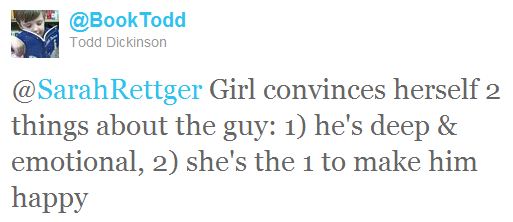
When it comes to Heathcliff, I'm with Lit_Gal. But you have to admit that, at least on the level of generalities, there's something to this whole melancholy/brooding thing. Otherwise, Beauty & the Beast1 would just be a tale of cross-species vindictiveness.

Which is, I think, what both Todd and Laurel are getting at. The Beast isn't antisocial, he's "deep & emotional"!
Anindita's response brought in the other cultural signifier that we usually associate with this kind of character: the Byronic hero.

Here, I have to admit to some gaps in my reading. Byron and his fellow Romantics just don't interest me much, so I have next to no firsthand knowledge of their work. But as a concept -- yeah, Byron & Co. have a lot to answer for.

(Like Heathcliff and Rochester. Having just spent a year-plus with Jane Eyre I'm not going to spend even more pixels on it here. And I've only read Wuthering Heights once (listened to it, actually -- it makes a great audiobook, with all those Yorkshire accents), so I just don't have the knowledge base to get into it.)

Anyway.

When I pushed back on Vladimir's initial response, he offered this, which I love (because I never would have come up with it myself)2:


A couple other things that did occur to me, based on some favorites:
  • The Bean Trees: Esteban is already off-limits. The fact that his very appealing melancholy is the result of a pretty horrific past just adds to that -- while making him attractive at the same time.
  • Major Pettigrew's Last Stand: In his review (which was what finally prompted me to actually read my ARC), Ron Charles wrote something4 along the lines of "the underlying sadness of the protagonists is what keeps this from being cloying and twee." Not that there's anything wrong with happy stories -- I've gone on the record many times with my sheer dislike of depressing books -- but there's something to be said for depth, too.
  • Dear Enemy: Sandy's standoffishness/moodiness/Scotchness/occasional moments of sunshine are what make him an effective foil for Sallie. There would be no relationship worth reading about if he were as frivolous/upbeat/playful/etc as she was.
  • Fire: A great line from the end of the book: "Your sadness is one of the things that makes you beautiful to me. Don't you see that? I understand it. It makes my own sadness less frightening." So is the enduring appeal of the Beast character the way that it lets us (collectively, in the abstract) deal with our own versions of brooding and melancholy?
What initially inspired all this musing wasn't a book. (Well, wasn't directly a book. I was enjoying the lovely Stewart Finlay-McLennan, but Neil MacNeill was rather the Beast in the original Christy.)

(Quick primer, for everyone who wasn't hooked on period dramas in the 90s.)


Still not sure I've answered my initial question. I've got some half-formed thoughts bopping around, but none that quite make sense. So I'm still working on the topic.

Anyone else?

1 For purposes of discussion, I'm using Beauty & the Beast -- not a particular version, just the story concept -- as the prototype for this kind of relationship in books and movies and such. Because if I kept typing "melancholy/brooding/etc." at every reference, you'd be just as tired of it as I would.
2 Of course, this is totally unrelated to my collosal Twitter-crush3 on @3rdplacepress. No connection whatsoever.
3 Which is not allowed to turn into a full-fledged twelve-year-old-girl-type crush because he's on the opposite side of the country from me.
4 I'd be happy to tell you precisely what he wrote, but the Washington Post wants me to pay for articles more than 60 days old, and this one ran in March 2010. I'm not whining about newspaper paywalls -- if Buick5 hadn't offered me free reading through the end of the year, I'd be paying my $20 to the Times each month -- but archive paywalls are just dumb.
5 No, I don't get it either. But I'll take it.