"But of course I was never introduced to her husband. And if we happened to pass in the common hallway, then his reaction was to look straight through me and at the wall. As if I was invisible, for all my newly gained flesh. And by doing this, he was showing his respect for me. Now, you have to work hard to get your head around that, that making someone invisible is a form of respect. I wasn't wearing a black veil, but he was dropping one over me."Being able to understand and accept the validity of an idea like that, without accepting it as true, is a writer's skill I'm still working on.

Sunday, June 16, 2013
Invisibility as a form of respect
On Friday, Fresh Air replayed part of a Hilary Mantel interview. It included this bit on Mantel's experience of life in Saudi Arabia:


Wednesday, May 8, 2013
Links: not dormant, just distracted
- Sara Zarr takes on L'Engle's Austin family
- The ABFFE Silent Auction has an online presence this year (all credit to the fab Kristen Gilligan Vlahos!)
- Buildings made from trees -- as in trees, not lumber
- Typography for Lawyers
- Analyzing the narrative features of breaking news
- For everyone who liked my "how to flirt with your bookseller" post -- Edwardian flirting!
- (Some) actual numbers on independent bookstores and e-books
- Trying to make academics write better
- Book snobbery smackdowns
- How privilege might apply to reading romance
- The historical fiction fan's tour of London

Tuesday, February 26, 2013
WiNot: Blog edition
Minions of Isidore is spot on. (On so many things. I don't know who's behind this blog, but s/he is brilliant.)

This is the third year now that I haven't been at Winter Institute, and oh yes I miss it. Two years ago, those of us in the Boston area who didn't make it to the main event in DC met up at Porter Square Books for the #WiNot Tweetup. This year, I just followed along via Twitter.
It's not the same as being there, especially when nuance is required. But there's still quite a lot to think about.
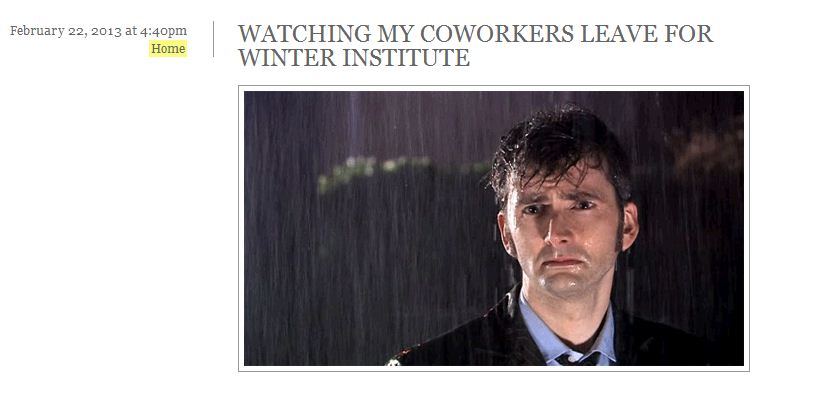
This is the third year now that I haven't been at Winter Institute, and oh yes I miss it. Two years ago, those of us in the Boston area who didn't make it to the main event in DC met up at Porter Square Books for the #WiNot Tweetup. This year, I just followed along via Twitter.
It's not the same as being there, especially when nuance is required. But there's still quite a lot to think about.
Tuesday, February 19, 2013
Links
- On being an introvert: Kelly, Liz, Charlotte
- On discoverability: Guy, Laura, Brett
- Leila is hosting Petersweek
- James Fallows on the latest State of the Union speech
- Worst neologism of the week: "boutique revivalism"
- An appreciation of the Post Office's social impact
- On writing for readers in an academic context
- From the perspective of an African-American WWI YMCA canteen worker
- Journalism skills for novelists
.JPG)
Friday, February 8, 2013
TBR alert
From today's Publishers Lunch: "Caitlin Fitz's OUR SISTER REPUBLICS, about how the early United States'
enthusiasm for foreign revolutions shaped popular U.S. understandings of race, rebellion, and republicanism"
Yes, please.
Yes, please.
Tuesday, February 5, 2013
Can I flirt with my bookseller?
With Valentine's Day around the corner, this is the question that is naturally on every book lover's mind: When I go into my local bookstore, am I allowed to start flirting with the staff?
.JPG)
Longer version: As long as you're not stupid about it. Aim to amuse yourself and others, not to get yourself banned from the bookstore. Please review these examples of what not to do if you are in any way uncertain as to what constitutes inappropriate behavior.
1. If someone encourages you to get a room, you're doing it wrong. Listen to Miss Manners:
"The tone should be 'Ah, had I but met you earlier -- had I but known that someone like you existed,' as opposed to 'How about giving it a whirl and seeing if it works?'"Which is not to say that the bookseller is necessarily averse to giving it a whirl, at some future point.
2. Buy something. The ideal time to begin the flirting process is when you hand over your item to check out. You've got a solid thirty seconds or so to make an impact, more if you do a good job and the bookseller isn't swamped.
3. Be aware of your surroundings. If there's a line behind you, your chance for flirtation is over as soon as you've collected your change. The bookseller's going to ignore you and move on to the next person waiting to give her money, because that's why she's there. (Hint: If there's already a line, spend a few minutes wandering the store. There's often a herd tendency around the cash wrap area, with everyone deciding to check out at once, followed by a five-minute lull.)
(Corollary: If you're attempting to flirt shortly before Christmas, Mother's Day, Father's Day, or major school vacations, it's probably not worth trying. The bookseller may be too swamped to even realize your intent, and even if she does, she'll be too overwhelmed to manage an appropriate reply until ten minutes after you've left the store. It's a missed opportunity for everyone.)
4. Talk about books. Not only is this appropriate to your surroundings, it also gives both you and the bookseller an easy starting point. You both like books. You both know books. Surely you can find a way to talk via books.
5. Be funny. This is banter, not Don Juan's greatest hits. Funny is charming, especially when it involves books.
6. Watch for signals. If the bookseller looks ready to end the conversation, let it go. Don't make her resort to "Sorry, I've got to go organize books in the back room" to get away from her. It's always easier for you to walk away than it is for the bookseller. (Assuming you've already paid. Don't forget that step.)
7. That means positive signals too. If the flirtation is going well, there may well be an option to extend it. If you mention that being single leaves a lot of time for reading, and the bookseller's response doesn't include "Well, somehow my husband finds time for it" or "I've got to go organize books in the back room," that may well be a positive signal.
8. Take a number. Remember Point 1? Don't push things too far in this first round. If you think the flirtation has a chance of moving on to bigger and better things, ask for the chance to try for it later on. As in "Hey, maybe we could get together sometime and see what 90s sci fi we've both read. Can I give you a call?" Which gives the bookseller an easy way to say "No, I really only want to talk to you when there's a substantial wooden barrier between us," or else "Sure, but texting me's the best way to get a response. Here's the number."
At that point, you're on your own.
Tuesday, January 22, 2013
The link harvest is good this week

- Medieval Judeo-Persian manuscripts have been discovered
- Elizabeth Wein on what makes a novel YA
- The story of Robert Smalls
- Wharton takes on Barnes & Noble
- Justine Larbalestier on genre-bashing
- Reading a book at the right age (to which I say "yes and no")
- On digital fact-checking (and the importance of links)
- Brett Sandusky says many smart things
- On the idea of selling out (or not)
Tuesday, January 8, 2013
Highlights of last year's reading
- Best vintage smackdown: Domestic Manners of the Americans, Fanny Trollope
- Runner-up: The Invention of Tradition (specifically, Hugh Trevor-Roper's chapter on the kilt)
- Most beat-up ARC by the time I got it: Bitterblue, Kristin Cashore
- Should have read this when it first came out: Wolf Hall, Hilary Mantel
- Runner-up: Holes, Louis Sachar
- Well, now I have to read the whole series: Island of Bones, Imogen Robertson
- Runner-up: Some Danger Involved, Will Thomas
- Most awesome cover design: One Came Home, Amy Timberlake
- Best dishy history: To Marry an English Lord, Gail MacColl and Carol McD. Wallace
- Best setup for the last book in the series: Speaking from Among the Bones, Alan Bradley
- Most worth slogging through a weak beginning for: The Fire Horse Girl, Kay Honeyman
- Journalism degree between two covers: Deadline Artists
- Perfect for high-school me: Watergate, Thomas Mallon
Saturday, December 15, 2012
Links (short version)
- Self-defense for women in 1942
- For those of us doing revisions, even of the non-NaNo variety
- Lee Child on writing suspense
- File under things I don't know enough about: the War of 1812
Tuesday, November 27, 2012
Great Expectations, post the second
Chapter 4
Chapter 5
Chapter 6
Don't forget, Leila's got the full list of posts over at Bookshelves of Doom!
- Spoke too soon. The Gargery-Pirrip family will be going through the Christmas rituals after all.
- "So, we had our slices served out, as if we were two thousand troops on a forced march instead of a man and boy at home; and we took gulps of milk and water, with apologetic countenances, from a jug on the dresser."
- "Mrs. Joe was a very clean housekeeper, but had an exquisite art of making her cleanliness more uncomfortable and unacceptable than dirt itself."
- "I was always treated as if I had insisted on being born in opposition to the dictates of reason, religion, and morality, and against the dissuading arguments of my best friends."
- "I opened the door to the company,—making believe that it was a habit of ours to open that door,—and I opened it first to Mr. Wopsle, next to Mr. and Mrs. Hubble, and last of all to Uncle Pumblechook. N.B. I was not allowed to call him uncle, under the severest penalties."
- " the Pumblechookian elbow in my eye"
- If you've gotten this far into the book and are not feeling profoundly sorry for Joe Gargery, I'm not sure we're on speaking terms any more. That man needs a hug. And while I don't remember all the details from the last time I read the book, I'm fairly sure he's not going to get one.
- For the moment, things look bad for Pip, as it turns out he didn't water down the brandy to cover what he gave the convict, he poured the infamous tar-water into it.
- There's another reference to the fact that Pip is looking back and telling this story, and it's a curiously phrased one: "I moved the table, like a Medium of the present day, by the vigor of my unseen hold upon it." But I guess the paranormal stuff didn't really get started until the last third of century.
- This is one of the rare occasions in literature where the arrival of soldiers bearing handcuffs is actually a good thing. In a way.
Chapter 5
- For a character who never gets a name of his own, the sergeant is a rather clever bit on Dickens' part. He knows just what to say to everyone -- and manages to flirt with Mrs. Joe while keeping a straight face.
- Poor Joe. Everyone else gets to sit around and drink wine while he has to follow his Christmas dinner with a stint at the anvil.
- "I thought what terrible good sauce for a dinner my fugitive friend on the marshes was."
- I love that Pip now thinks of the man as "my particular convict."
- Curiouser and curiouser: When they catch the two convicts down at the marshes, Pip's convict makes a point of noting that he captured the other one. When the sergeant points out it's not likely to get him any time off, "'I don't expect it to do me any good. I don't want it to do me more good than it does now,' said my convict, with a greedy laugh. 'I took him. He knows it. That's enough for me.'"
- Clearly there's a history between these two men. Otherwise, wouldn't they put a little more effort into dealing with the fact that the soldiers have recaptured them?
- "It had been almost dark before, but now it seemed quite dark, and soon afterwards very dark."
- And Pip's convict is demonstrating his humanity here, claiming he stole the food Pip brought him. This chapter is really just a stroke of luck for Pip.
Chapter 6
- This is an excessively short chapter.
- Why Pip doesn't make a confession of his own: "The fear of losing Joe's confidence, and of thenceforth sitting in the chimney corner at night staring drearily at my forever lost companion and friend, tied up my tongue."
- And there's the theme, right there: "In a word, I was too cowardly to do what I knew to be right, as I had been too cowardly to avoid doing what I knew to be wrong. I had had no intercourse with the world at that time, and I imitated none of its many inhabitants who act in this manner. Quite an untaught genius, I made the discovery of the line of action for myself."
Don't forget, Leila's got the full list of posts over at Bookshelves of Doom!
Tuesday, November 20, 2012
Great Expectations, post the first
Leila is blogging Great Expectations. Which is awesome. (Follow her posts here.)
I haven't read it all the way through since high school.1 So let's see how far this attempt goes.
Chapter 1
Chapter 2
Chapter 3
I haven't read it all the way through since high school.1 So let's see how far this attempt goes.
Chapter 1
- Dickens knew his openings: "My father's family name being Pirrip, and my Christian name Philip, my infant tongue could make of both names nothing longer or more explicit than Pip. So, I called myself Pip, and came to be called Pip." It doesn't make a lot of sense (or rather, parents who stick their kid with the name Philip Pirrip don't make sense, though they're certainly plausible), but the way he says it suggests there's more to it.
- It's always struck me as odd when adults in nineteenth-century fiction call each other by their married names, especially when they grew up together (e.g. "my sister Mrs. Norris), but Pip only thinking of his sister as Mrs. Joe? Totally makes sense.
- I am a sucker for marshes. Have I mentioned that before?
- Also skillful: first-person narration that keeps its distance from the narrator: "At such a time I found out for certain that this bleak place overgrown with nettles was the churchyard; and that Philip Pirrip, late of this parish, and also Georgiana wife of the above, were dead and buried; and that Alexander, Bartholomew, Abraham, Tobias, and Roger, infant children of the aforesaid, were also dead and buried; and that the dark flat wilderness beyond the churchyard, intersected with dikes and mounds and gates, with scattered cattle feeding on it, was the marshes; and that the low leaden line beyond was the river; and that the distant savage lair from which the wind was rushing was the sea; and that the small bundle of shivers growing afraid of it all and beginning to cry, was Pip"
- The convict? Utterly terrifying. And yet we're not very much in Pip's head here; we get lines like "I earnestly expressed my hope that he wouldn't."
- The w-for-v substitution in "wain" and "wittles" -- what dialect is that supposed to be?
- More great writing: "The marshes were just a long black horizontal line then, as I stopped to look after him; and the river was just another horizontal line, not nearly so broad nor yet so black; and the sky was just a row of long angry red lines and dense black lines intermixed."
Chapter 2
- Does Mrs. Joe have any redeeming qualities? We certainly don't find out about them when we first meet her.
- Of course, Joe has his merits, but Dickens isn't too kind to him either: "a sort of Hercules in strength, and also in weakness."
- "Tickler was a wax-ended piece of cane, worn smooth by collision with my tickled frame."
- Pip gets tucked into the chimney and then out onto a stool in a matter of sentences. There is clearly room for exploration here if you're turning this into a film.
- Mrs. Joe's bread-and-butter preparations? Oh, my. What a look into the household.
- Secreting one's bread in one's trouser leg is never a simple operation: "The effort of resolution necessary to the achievement of this purpose I found to be quite awful."
- "At the best of times, so much of this elixir was administered to me as a choice restorative, that I was conscious of going about, smelling like a new fence."
- It's Christmas Eve. And we're only just now finding this out. The Germans have definitely not made their impact on English traditions yet. (Because, after all, Pip is looking back to his youth, which must have been pre- or proto-Victorian.)
- "But she never was polite unless there was company."
- "from Mrs. Joe's thimble having played the tambourine upon it, to accompany her last words"
Chapter 3
- Does this remind anyone else of the troll in Harry Potter? "I had seen the damp lying on the outside of my little window, as if some goblin had been crying there all night, and using the window for a pocket-handkerchief."
- "One black ox, with a white cravat on,—who even had to my awakened conscience something of a clerical air"
- Pip's definitely identifying with the convict here. First the bread down his trousers reminds him of the leg irons, and now it's the way the cold attaches itself to his feet.
- "Something clicked in his throat as if he had works in him like a clock, and was going to strike."
Saturday, November 17, 2012
Reading break links
I'm halfway through Paul Shackel's Memory in Black and White, so I've put down the notebook for a few minutes so I can post some links instead:
- An excellent use of Photoshop
- Mr. Rogers in infographic form (side note: if your Facebook friends weren't among those reposting the picture of Mr. Rogers with Koko the gorilla, you don't have enough sentimental nerds in your life)
- Created land is poorly drained? Who would have thought?
- What Turing's Cathedral leaves out
- Digital humanities in action: making ancient documents legible
- Alexander McCall Smith on early female detectives
- Someday I'm going to write about why James Fallows is a brilliant writer, but for now just read for yourself
- I was totally hooked by Henry Wiencek's book teaser in Smithsonian, so the reviews (especially from my historian-hero Annette Gordon-Reed) are fascinating
- The reading skills journalists need
- An in-depth look at the first show I ever got hooked on
Sunday, November 4, 2012
Why I Vote
It sounds glib, but I'm voting because there is absolutely no reason not to.
- It's legal. Nothing stopping me there.
- I'm registered in Massachusetts. Even that was almost frictionless. I filled out a form at a table set up directly in front of my T stop on National Voter Registration Day, and a week or two later, my confirmation arrived in the mail.
- I have time. Polling stations here are open from 7 AM to 8 PM on Tuesday. (Yes, Tuesday. Apparently there are robocalls in the area suggesting otherwise. Nope.) I start work at 9 and get out of class by 6:30.
- I know who I'm going to vote for. None of that undecided business here. (And I care about the outcome of the two important races on the ticket.)
- My polling place is easy to get to. I walk down the street two blocks, turn the corner, and I'm there. (It is not, however, the closest I've ever lived to where I vote. When I lived in Wisconsin, I voted at the DMV branch directly across the street from my apartment. Wisconsin also had same-day registration, which was great.)
Wednesday, October 31, 2012
Need a writing prompt?
This guy works with robots, and he thinks that "at some point, we have to get over" emergency shutoff buttons.
Speaking of which: robot bees.
"I can tell you, it's strange to write a research proposal and have half your bibliography be science fiction."
Forget parrots, this beluga is trying to speak human.
A transcript of the Bretton Woods conference was just rediscovered.
Speaking of which: robot bees.
"I can tell you, it's strange to write a research proposal and have half your bibliography be science fiction."
Forget parrots, this beluga is trying to speak human.
A transcript of the Bretton Woods conference was just rediscovered.
Tuesday, October 23, 2012
All I have time for is links
- One of those times you can't improve on the headline: "Orca Mothers Coddle Adult Sons, Study Finds"
- On the other hand: boring headlines abound
- Apropos of the romance post: Eloisa James on her dual identity
- How Andrew Karre defines YA
- What we need more of: made-up nobility
- Go read David on spoilers
- Laptops and latent sexism
- A 1982 paean to computers in journalism
- The early days of CBS News
- Marketing diamonds (trust me, it's worth the read)
- Best amicus brief ever?
- Beatrix Potter's recipes (not for rabbit pie)
- I'm with Liz on social reading
- The problem with talking about "small business"
- Amateur scientists, totally new solar system configuration -- what's not to love?
- Digitized dresses to drool over at the Met
- Backlist-midlist conflict
Saturday, September 29, 2012
Bookstores and romance
1. A couple years back, I agitated for -- and then organized -- a romance-focused session
at Winter Institute. An RWA staffer and a couple booksellers from
member stores that offered decent romance sections told booksellers what
romance readers expect, and why they should care.
2. I’m a fan of romance without actually being a big reader of it. The truth is, I’m kind of a prude. Also, I’m a bitter single lady. We offer full disclosure here at Archimedes Forgets!
3. There have been versions of this post written every few months, with the same sort of arguments hashed out in the comments. And to be fair, I’m probably not saying anything new here either.
4. Don’t even get me started on the difficulty of trying to apply any sort of absolute to the independent bookstore sector. Which is not to say I haven’t done it before, because it’s human nature to look for the defining characteristics of a group.
5. What I feel reasonably confident in saying about indie booksellers as a class is that they don’t like being told what to do. I think that, even more than platitudes we throw around like “a passion for books,” is why people are willing to make sacrifices to run or work for small retail enterprises.
6. When I talk about independent bookstores, I mean the ones that sell entirely or primarily new books. I know next to nothing about the used book business.
7. Romance readers have, in general, been poorly served by many independent bookstores over the past decade. (Quite probably before that, too.) I’m not arguing with that premise. I’m not saying that romance readers should feel any sense of obligation to stores that don’t meet their needs.
8. We -- readers -- don’t make coldly practical economic decisions when it comes to books. If I’m talking about a clothing store that carries dresses outside my price range or below my size, I can be fairly dispassionate about it, but if a bookstore doesn’t carry the authors and genres I like -- especially if there’s an indication that they actively disdain them -- there’s more of a sense of judgment. Psychology people, have at it.
9. Booksellers are used to hearing complaints about their selection. Last week a customer told my coworker that he hated our store because we don’t carry computer books. A couple months back, a customer told me that she had stopped shopping with us because we carry too many new bestsellers and commercial fiction writers. It’s easy to accept that you can’t please everyone, but there are days when it feels like you can’t please anyone.
10. Shelf space is always a problem. Even stores that want to increase their romance (or whatever) inventory have trouble finding a place to stock it. Part of the problem is that bookcases are large pieces of furniture with fixed dimensions. It doesn’t help your picture book overflow if you’re able to free up half a shelf in memoir and one shelf in sports.
11. I don’t know what fraction of the book-browsing population notices, but cheap paper does not age well. The groundwood used in pretty much all mass-markets (along with an increasing number of trade paperbacks) turns yellow very quickly. If something’s been sitting on the shelves for a while, it shows.
12. There’s often a significant overlap between a store’s customers and its employees -- many booksellers started out as customers. So a store that isn’t drawing romance-reading customers is unlikely to acquire romance-reading employees unless they look elsewhere. (Thanks to Ann Kingman for pointing this out in the comments to a Booksquare post, ages and ages ago.)
13. Romance readers are well-served by e-books. Independent bookstores are not. This gap in interests may prove to be unbridgeable.
14. No store can be right for everybody. If you’re looking for an inexpensive book to read once and get rid of, a used bookstore is probably the best fit. This isn’t the “fault” of the independent bookstore selling new books at their cover price, it’s just another gap in interests.
15. There are, without question, a non-trivial number of book snobs working in independent bookstores. (And probably chain stores as well.) Some of these people have no compunctions about sharing their snobbery with the objects of it. Which sucks, because it’s very easy for a bad experience in a single store to color a customer’s feelings about independent bookstores in general. (Which brings us back to #5.)
16. For the record, I’m far from perfect, but I do try really hard not to display any judgment on people’s reading choices. (I wanted to say “not to pass judgment,” but who am I kidding? I judge based on footwear, hairstyle, and whether you understand the proper use of “literally.” I just try not to show it.) I’m no fan of Fifty Shades of Grey (see prudery reference above), but I’m not going to mock you for asking for it. Even if you’re the one saying derogatory things about it.
17. I don’t see any grand solution to the romance reader-independent bookstore divide. I’m not sure there is one. I think there are stores that could benefit from making themselves more amenable to the wants of romance fans, and I think there are stores for which it would be more trouble than it’s worth. And I know I can’t tell any store what to do with its inventory. But I can add my own whinging to the mix when I hear the same complaints again and again.
(Post format shamelessly cribbed from Chasing Ray. When La Colleen starts numbering her paragraphs, watch out.)
2. I’m a fan of romance without actually being a big reader of it. The truth is, I’m kind of a prude. Also, I’m a bitter single lady. We offer full disclosure here at Archimedes Forgets!
3. There have been versions of this post written every few months, with the same sort of arguments hashed out in the comments. And to be fair, I’m probably not saying anything new here either.
4. Don’t even get me started on the difficulty of trying to apply any sort of absolute to the independent bookstore sector. Which is not to say I haven’t done it before, because it’s human nature to look for the defining characteristics of a group.
5. What I feel reasonably confident in saying about indie booksellers as a class is that they don’t like being told what to do. I think that, even more than platitudes we throw around like “a passion for books,” is why people are willing to make sacrifices to run or work for small retail enterprises.
6. When I talk about independent bookstores, I mean the ones that sell entirely or primarily new books. I know next to nothing about the used book business.
7. Romance readers have, in general, been poorly served by many independent bookstores over the past decade. (Quite probably before that, too.) I’m not arguing with that premise. I’m not saying that romance readers should feel any sense of obligation to stores that don’t meet their needs.
8. We -- readers -- don’t make coldly practical economic decisions when it comes to books. If I’m talking about a clothing store that carries dresses outside my price range or below my size, I can be fairly dispassionate about it, but if a bookstore doesn’t carry the authors and genres I like -- especially if there’s an indication that they actively disdain them -- there’s more of a sense of judgment. Psychology people, have at it.
9. Booksellers are used to hearing complaints about their selection. Last week a customer told my coworker that he hated our store because we don’t carry computer books. A couple months back, a customer told me that she had stopped shopping with us because we carry too many new bestsellers and commercial fiction writers. It’s easy to accept that you can’t please everyone, but there are days when it feels like you can’t please anyone.
10. Shelf space is always a problem. Even stores that want to increase their romance (or whatever) inventory have trouble finding a place to stock it. Part of the problem is that bookcases are large pieces of furniture with fixed dimensions. It doesn’t help your picture book overflow if you’re able to free up half a shelf in memoir and one shelf in sports.
11. I don’t know what fraction of the book-browsing population notices, but cheap paper does not age well. The groundwood used in pretty much all mass-markets (along with an increasing number of trade paperbacks) turns yellow very quickly. If something’s been sitting on the shelves for a while, it shows.
12. There’s often a significant overlap between a store’s customers and its employees -- many booksellers started out as customers. So a store that isn’t drawing romance-reading customers is unlikely to acquire romance-reading employees unless they look elsewhere. (Thanks to Ann Kingman for pointing this out in the comments to a Booksquare post, ages and ages ago.)
13. Romance readers are well-served by e-books. Independent bookstores are not. This gap in interests may prove to be unbridgeable.
14. No store can be right for everybody. If you’re looking for an inexpensive book to read once and get rid of, a used bookstore is probably the best fit. This isn’t the “fault” of the independent bookstore selling new books at their cover price, it’s just another gap in interests.
15. There are, without question, a non-trivial number of book snobs working in independent bookstores. (And probably chain stores as well.) Some of these people have no compunctions about sharing their snobbery with the objects of it. Which sucks, because it’s very easy for a bad experience in a single store to color a customer’s feelings about independent bookstores in general. (Which brings us back to #5.)
16. For the record, I’m far from perfect, but I do try really hard not to display any judgment on people’s reading choices. (I wanted to say “not to pass judgment,” but who am I kidding? I judge based on footwear, hairstyle, and whether you understand the proper use of “literally.” I just try not to show it.) I’m no fan of Fifty Shades of Grey (see prudery reference above), but I’m not going to mock you for asking for it. Even if you’re the one saying derogatory things about it.
17. I don’t see any grand solution to the romance reader-independent bookstore divide. I’m not sure there is one. I think there are stores that could benefit from making themselves more amenable to the wants of romance fans, and I think there are stores for which it would be more trouble than it’s worth. And I know I can’t tell any store what to do with its inventory. But I can add my own whinging to the mix when I hear the same complaints again and again.
(Post format shamelessly cribbed from Chasing Ray. When La Colleen starts numbering her paragraphs, watch out.)
Friday, September 7, 2012
This week's links
- A book on women in early Hollywood? Yes, please.
- More problems with cities below sea level: when saltwater enters the aquifers.
- How-to-manage-women manuals that are really more about dealing with all employees.
- Was the Gloucester sea serpent just a whale in a fishing net?
- I don't completely agree with David's anti-sticker-book rant, but I do admire his passion.
Tuesday, September 4, 2012
The Adventure of the Reigate Squire
Also known, in the Project Gutenberg edition, as "The Reigate Puzzle."
Sherlock Holmes has definitely not made it into popular memory as a fragile man, but that's almost the image Watson paints in the opening paragraph:
Besides the Conan Doyle's ongoing "everything you see here is real" conceit, with all the dashed-out names and "oh, I couldn't possibly tell you but I know you'd recognize the reference if I did" moments, these digressions from the narrator make the Holmes universe that much bigger. It's not just fifty-some little stories, it's so many adventures Watson couldn't possibly manage to write them all down, even if he were allowed to.
Anyway. On April 14, 1887 (Watson specifies), Holmes is suffering from "nervous prostration" after the conclusion of a particularly grueling case. It takes some cajoling, but Watson manages to drag him off to a friend's country house.
Tell me, does this sound like the kind of houseguest you want?
You can just hear the long-sufferingness in Watson's narration when Holmes inevitably gets involved in the case:
Of note: Holmes' experiences with the police have resulted in an amusingly low level of expectations of their competence:
And a lesson: Whenever Watson thinks that Holmes is losing his touch, you can be pretty sure a major clue has just been unearthed. This story's example:
Sherlock Holmes has definitely not made it into popular memory as a fragile man, but that's almost the image Watson paints in the opening paragraph:
"It was some time before the health of my friend Mr. Sherlock Holmes recovered from the strain caused by his immense exertions in the spring of '87."But of course Watson can't actually tell us what those exertions were, because they're "too intimately concerned with politics and finance to be fitting subjects for this series of sketches."
Besides the Conan Doyle's ongoing "everything you see here is real" conceit, with all the dashed-out names and "oh, I couldn't possibly tell you but I know you'd recognize the reference if I did" moments, these digressions from the narrator make the Holmes universe that much bigger. It's not just fifty-some little stories, it's so many adventures Watson couldn't possibly manage to write them all down, even if he were allowed to.
Anyway. On April 14, 1887 (Watson specifies), Holmes is suffering from "nervous prostration" after the conclusion of a particularly grueling case. It takes some cajoling, but Watson manages to drag him off to a friend's country house.
Tell me, does this sound like the kind of houseguest you want?
"A little diplomacy was needed, but when Holmes understood that the establishment was a bachelor one, and that he would be allowed the fullest freedom, he fell in with my plans"After he's had some time to mope around, Holmes perks up when he hears that there's been a burglary in the area, with unusual results:
"The thieves ransacked the library and got very little for their pains. The whole place was turned upside down, drawers burst open, and presses ransacked, with the result that an odd volume of Pope's 'Homer,' two plated candlesticks, an ivory letter-weight, a small oak barometer, and a ball of twine are all that have vanished."Which gives us a chance to watch our two protagonists in opposition. Holmes, as always, zeroes in on an oddity that makes perfect sense to him, while Watson has no idea what he's talking about and dismisses the whole thing -- in this case, by reminding Holmes that detecting isn't much help in a rest cure.
You can just hear the long-sufferingness in Watson's narration when Holmes inevitably gets involved in the case:
"It was destined, however, that all my professional caution should be wasted, for next morning the problem obtruded itself upon us in such a way that it was impossible to ignore it, and our country visit took a turn which neither of us could have anticipated."The burglars, it turns out, have now taken in a second estate, adding murder to their rap sheet. And it just happens that the two targeted houses happen to belong to landowners with a persistent grudge between them.
Of note: Holmes' experiences with the police have resulted in an amusingly low level of expectations of their competence:
"I have made inquiries," said the Inspector. "William received a letter by the afternoon post yesterday. The envelope was destroyed by him."Recourse to Google: Watson observes that the house "bears the date of Malplaquet upon the lintel of the door." For those of us who lack his grounding in English history, that would be the 1709 Battle of Malplaquet, part of the Wars of Spanish Succession.
"Excellent!" cried Holmes, clapping the Inspector on the back. "You've seen the postman. It is a pleasure to work with you..."
And a lesson: Whenever Watson thinks that Holmes is losing his touch, you can be pretty sure a major clue has just been unearthed. This story's example:
"I was pained at the mistake, for I knew how keenly Holmes would feel any slip of the kind. It was his specialty to be accurate as to fact, but his recent illness had shaken him, and this one little incident was enough to show me that he was still far from being himself. He was obviously embarrassed for an instant, while the Inspector raised his eyebrows, and Alec Cunningham burst into a laugh. The old gentleman corrected the mistake, however, and handed the paper back to Holmes."Also, this week in the insights of Sherlock Holmes:
"It is of the highest importance in the art of detection to be able to recognize, out of a number of facts, which are incidental and which vital. Otherwise your energy and attention must be dissipated instead of being concentrated."
Friday, August 24, 2012
Meet Stompy (and other links)
- Apparently Boston's getting a new robotic neighbor
- Mars exploration family portrait
- "Would you ever ask a man that question?"
- Elephants communicate with infrasounds
- Rosalind Franklin's sister has written a book
- The Times presents backyard animals
- Go check out the beginning of the lovely Gwenda's new book!
Thursday, August 23, 2012
Holmes Project: The Adventure of the Dancing Men
This time we're opening with a bit of authorial soliloquizing on Watson's part:
By the time his little game is over, the latest client has arrived, a Mr. Hilton Cubbitt, "a tall, ruddy, clean-shaven gentleman, whose clear eyes and florid cheeks told of a life led far from the fogs of Baker Street."
Holmes sets up the framing this time: "You gave me a few particulars in your letter, Mr. Hilton Cubitt, but I should be very much obliged if you would kindly go over it all again for the benefit of my friend, Dr. Watson." And so Cubbitt gets to tell his own story, although he begins by denigrating his own narrative abilities. Always fake confidence, Hilton. It's the secret of success.
But actually, he starts off by giving us a clue. It doesn't seem that way at first, just an example of the traditional emphasis on family connections, but in this case it turns out to matter.
The actual mystery here is of less interest to me than the sociological aspect. Short version, Holmes cracks a murder case by solving a substitution cipher that involves the dancing men of the title -- not too difficult for someone who's written "a trifling monograph upon the subject."
"Holmes had been seated for some hours in silence with his long, thin back curved over a chemical vessel in which he was brewing a particularly malodorous product. His head was sunk upon his breast, and he looked from my point of view like a strange, lank bird, with dull gray plumage and a black top-knot."And then the strange, lank bird proceeds to explain to Watson how it's totally obvious he's not going to be investing in South African securities -- which, by the way, seem to be a favorite choice of Conan Doyle's investment-minded characters.
By the time his little game is over, the latest client has arrived, a Mr. Hilton Cubbitt, "a tall, ruddy, clean-shaven gentleman, whose clear eyes and florid cheeks told of a life led far from the fogs of Baker Street."
Holmes sets up the framing this time: "You gave me a few particulars in your letter, Mr. Hilton Cubitt, but I should be very much obliged if you would kindly go over it all again for the benefit of my friend, Dr. Watson." And so Cubbitt gets to tell his own story, although he begins by denigrating his own narrative abilities. Always fake confidence, Hilton. It's the secret of success.
But actually, he starts off by giving us a clue. It doesn't seem that way at first, just an example of the traditional emphasis on family connections, but in this case it turns out to matter.
"I'll begin at the time of my marriage last year, but I want to say first of all that, though I'm not a rich man, my people have been at Riding Thorpe for a matter of five centuries, and there is no better known family in the County of Norfolk... You'll think it very mad, Mr. Holmes, that a man of a good old family should marry a wife in this fashion, knowing nothing of her past or of her people, but if you saw her and knew her, it would help you to understand."Just in case you don't understand straight off that one of the themes of the story is the value of maintaining family pride -- and Englishness -- Conan Doyle keeps hammering the point.
"He was a fine creature, this man of the old English soil—simple, straight, and gentle, with his great, earnest blue eyes and broad, comely face. His love for his wife and his trust in her shone in his features."Also of note: Mrs. Hudson makes an appearance here only in a most indirect fashion:
"She has spoken about my old family, and our reputation in the county, and our pride in our unsullied honour"
"Dear, dear, one of the oldest families in the county of Norfolk, and one of the most honoured."
"Ah! here is our expected cablegram. One moment, Mrs. Hudson, there may be an answer."We're back in the Austen zone of servants who spend most of the story invisible.
The actual mystery here is of less interest to me than the sociological aspect. Short version, Holmes cracks a murder case by solving a substitution cipher that involves the dancing men of the title -- not too difficult for someone who's written "a trifling monograph upon the subject."
Subscribe to:
Posts (Atom)